Did Virginia Woolf Comment on Vorticism?
Monday, August 20, 2012
I have spent the last couple of weeks writing a paper comparing computer games to developments in literary modernism. One of the fascinating things about the modernist period is the way in which visual artists and literary writers interacted and drew inspiration to radicalise their traditional forms of working through thinking about the aesthetics of other media. Most notably, for example, Virginia Woolf wrote her innovative short story, "Kew Gardens," on the back of an exhibition of post-impressionist painting. Briefly, I am trying to think about why it is that our contemporary writers (particularly novelists) do not seem to have been correspondingly affected by the advent of computer games, and the new narrative and artistic possibilities they seem to bring to bear.
In the process of researching what has turned out to be quite a complex essay, I have come across what appears to be a curious gap in relation to Woolf and visual art. Throughout her diaries and letters, Woolf continually professes her interest in developments in the visual arts. It was a visit to the 1910 exhibition of "Manet and the Post-Impressionists" which caused her to make one of the most reiterated (if now hackneyed) pronouncements of modernism that "on or about December 1910, human character changed." She enthusiastically essays by her friend and member of the Bloomsbury group, Roger Fry, and was thinking about these when she wrote her early short stories such as "Kew Gardens" or "The Mark on the Wall" (the latter of which almost directly lifts a quote from Fry's
Vision and Design). In a 1922
essay on Proust, Woolf declares that "We are under the dominion of painting" and contends that "Were all modern paintings to be destroyed, a critic of the twenty-fifth century would be able to deduce from the works of Proust alone the existence of Matisse, Cezanne, Derain, and Picasso; he would be able to say with those books before him that painter of the highest originality and power must be covering canvas after canvas, squeezing tube after tube, in the room next door." One can similarly say that Woolf's own novel
To the Lighthouse (1925) - which centres around the efforts of Lily Briscoe to paint Mrs Ramsay - could not have occurred were it not for the parallel movement of modern painting.
So one might have expected Woolf to have something to say about the advent of the Vorticist movement, which seemed to present the interaction of media, visual and literary, in the most prominent fashion. The arrival of Vorticism was represented by the first issue of
Blast! magazine (1914), which was produced by Wyndham Lewis, who was both an artist and a writer, in collaboration with that perennial sponsor of experimentalism, Ezra Pound. This seems a truly multimedia work, mixing visual art, poetry, prose and politics, and using typography to represent the crossover between literature and art. As well as Lewis and Pound, contributions came from Jacob Epstein, Spencer Gore, Wadsworth, Rebecca West, and Ford Madox Ford. (For the full flavour of the magazine, explore the digitised versions at the
Modernist Journals Project)
With its bright pink cover differentiating it from other magazines of the period,
Blast! attracted a
certain amount of attention. The Chicago modernist magazine
Little Review described it as as “something between magenta and lavender, about the colour of a sick headache” and the
Pall Mall Gazette noted it was “chill flannelette pink.” An advertisement for the journal in
The Egoist promoted it in the hyerbolic manner of a commodity as “THE CUBE, THE PYRAMID / Putrefaction of Guffaws Slain by Appearance of / BLAST. / No Pornography. No Old Pulp. / END OF THE CHRISTIAN ERA.” The Vorticist manifesto - with its demand to "Blast first England" and "Convert the King" - was every bit as controversial as Marinetti's "
Futurist Manifesto" or the first post-impressionist exhibition of 1910 which caused a stir in the popular press.
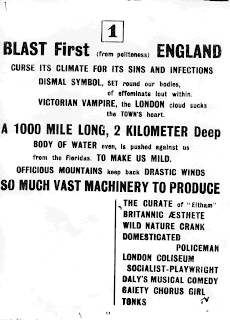
It seems hard to conceive, then, that Woolf did not know or hear about what was a remarkable and, ultimately, significant intervention on the stage of modernist aesthetics. However, nowhere in her diaries or letters for the period covering the two issues of
Blast! does Woolf make any mention of the magazine, or for that matter of Vorticism. She mentions Lewis and Pound only very briefly and tangentially. It seems odd that someone who was otherwise heavily engaged in the intersections of visual and literary art should be uninterested in a magazine which seems of its time quite important (if also self-important).
One reason for this gap might be that it is a wilfully cultivated ignorance, stemming from Woolf's antagonistic relations with both Pound and Lewis. In a letter of 1918 to Roger Fry, Woolf reports of her first meeting with Pound's protege, T.S. Eliot, whom she describes as a "strange young man." Their conversation got as far as discussing Pound, Lewis and Joyce, and whilst Woolf is inclined to agree with Eliot that the latter is a "great genius," she says of Pound: "Not that I've read more than 10 words by Ezra Pound by [sic] my conviction of his humbug is unalterable." Was
Blast! just another example of his "humbug," and so not worthy of mention?
Woolf and Lewis were similarly conflicted. Lewis had been prompted to develop Vorticism after falling out with Roger Fry, who had mentored Lewis at his workshop at the Omega gallery and who included Lewis in his second exhibition of post-impressionist painting in 1912. In 1914, feelings between Lewis and Fry were still raw, and Woolf's allegiances certainly lay with the latter, with whom she sustained a long correspondence and whose art theories influenced her later prose. Conversely, Lewis would later (in 1938) describe Woolf as "a sort of party-lighthouse," a symbol for the feminist movement but of exaggerated literary importance. So was Woolf allying herself with her friend by refusing to read
Blast!?
Both of these seem reasonable possibilities. The third option is that Woolf did in fact read or at least know of
Blast! but did not comment upon it explicitly in her letters or her diaries - hence why I have been unable to track down any mention of the magazine in her writings. However, the fourth possibility is that, not being a scholar of the modernist period, I may well be missing some glaringly obvious link or a reference to
Blast! or the Vorticists elsewhere in Woolf's writing. If anyone can get in touch to correct me, or to confirm that indeed Woolf either did not read or did not comment on this particular movement, I would be very grateful.
Labels: Blast, English Literature, Ezra Pound, Virginia Woolf, Vorticism, Wyndham Lewis
A Pound for Pound: Modernist Elitism
Wednesday, February 15, 2012
As part of my research into a textbook on modernism (about which I keep meaning to blog, whilst failing to find time to do so) I was interested to read in Lawrence Rainey's account of the economics of modernism (in
The Cambridge Companion to Modernism
) about a series of lectures given by the modernist poet, Ezra Pound.
Modernism was, for its critics, a notoriously elitist affair. That early period of the twentieth century was sandwiched by nineteenth-century authors such as Dickens, who consciously appealed to a buying public, and post-modernism, which happily embraced mass culture and media. Between these two populist movements, modernist authors sought to distance themselves from the crowd. As Peter Carey pointed out in his controversial book on
The Intellectuals and the Masses, modernism can be understood as a reaction to the large reading public who were created by the educational reforms of the nineteenth century. Modernist authors sought to be elite and difficult, to form cliques and cabals (most famously the Bloomsbury group) of like-minded intellectuals. To some extent, this persists today. Who outside of the academy reads
The Waste Land or
Ulysses?
Rainey shows further evidence of modernism's elitist economics in a set of three lectures that Pound gave at the home of a wealthy aristocratic family:
The price for the three lectures was a steep one, £1 1s, slightly less than the weekly wage of the average male industrial worker. The audience was "limited to fifty," as a contemporary program announced, and the site was to be the "private gallery" of Lord and Lady Glenconner, located at 34 Queen Anne's Gate. With no expenses to cover (the event was offered "by the kind permission" of the Glenconners), Pound might earn between £50 and £60. Equally vital, however, was the effort to endow the lectures with an aura of aristocratic glitter, to distinguish them from mere offerings of the contemporary economy. Programs were not posted in public places, but privately distributed; tickets were not commodities to be purchased, but favors to be courteously requested ("TICKETS may be had on application to Lady Low," the program stated; Lady Low lived just off Kensington Gardens and hosted "evenings at home" for a circle of upper middle-class intellectuals including G. W. Prothero, editor of the Quarterly Review).
As a teacher I have qualms about the word elitism, as it risks rewarding mediocrity and undervaluing those who are genuinely more capable than others. But as a participant in literary culture, the anti-elitist trend of the last two decades or so, for which New Labour was condemned, has had great benefits. We could not be further from the conscious exclusivity cultivated by Pound, in our modern era of free museum entry, blockbuster exhibitions at galleries, and programmes of outreach and education that all our cultural institutions are required to perform to receive public funding. It is surely something to be grateful for that I can think of no author today who, wanting to promote their work, would be willing or able to charge the admission fee of an average weekly wage.
Labels: elitism, English Literature, Ezra Pound, modernism
Daily Diary: The Waste Land Transcripts
Tuesday, January 19, 2010
Again, today I have virtually no time to do reading. I mark essays until midday, and then have to head over to Stockton, for meetings and a library shift from 2.00 to 8.00.
I manage to snatch an hour, though, to spill lunchtime lettuce onto the pages of Valerie Eliot's introduction to the facsimile edition of
The Waste Land, featuring Ezra Pound's substantial annotations. The introduction is told largely through Eliot's letters, and the impression that comes across is of how difficult Eliot, now one of the most revered figures in twentieth-century letters, found it to make either a name or a living for himself, and of how tenderly he felt towards his first wife, Vivien.
The mentoring of Pound was vital to Eliot's ambition, as was the financial sponsorship of wealthy philanthropist John Quinn, although Pound's letter of introduction to the latter is hardly flattering. Eliot, Pound writes, "has more entrails than might appear from his quiet exterior." Although Eliot's reputation became more secure with the publication of "Prufrock," he remained itinerant, flitting around England (and disappointing his American parents in the process) in the hunt for a job that would sustain him financially whilst allowing him time to lecture and write.
Eventually, he settled at Lloyd's Bank (one wonders if, today, the taxpayer-owned Lloyd's might be forced to become a sponsor of unsettled academics and literary genuises by way of remittance for the bail-out). Whilst he enjoyed the bank work, having published
The Waste Land in
The Dial in 1922, one might have expected Eliot to be able to turn now to writing full time. Behind the scenes, indeed Pound developed a scheme known as the
Bel Esprit, where he tried to persuade thirty guarantors to sponsor Eliot for £10 a year. Eventually, Quinn pledged £300 a year, but Eliot remarkably turned down this generous offer, in favour of keeping his £500 a year salary at the bank. Later the next year, Quinn offered an alternative, with Eliot becoming editor of
Nation for $600 annually, paid by himself and Otto Kahn. Again, Eliot rejected this "extraordinarily generous offer."
The reason, touchingly, appears to have been the ill health of his first wife, Vivien. Thomas wrote to Quinn explaining that:
The Nation did not want to give more than six months’ guarantee and they wanted me at once if at all. I pointed out that this might be allright for a man who was already in journalism, but that it is quite different for a man who had to give up a secure post. I don’t know whether I have ever explained this to you, but the Bank is a secure job for life, with a pension at 60, and a year’s salary and a pension for my wife in the event of my death. The main point, in any question of leaving the Bank, is (as I explained to Pound) the security for my wife. She will never be strong enough to shift for herself, or to endure great privation, she will inherit very little...and I must make reasonable provision for her before undertaking any adventures. I have gone into these details, for the first time, because it might appear, and I daresay has appeared to people who do not know my circumstances, that I am either very cowardly or very grasping. If I appear in this light to you, please let me know.
I do regard it as a disaster that I could not come to an arrangement with the Nation, and if the same post, or any similar post, should be open to me in the future, I should take it. I mean to leave the bank, and I must leave the bank, but I cannot say how soon or in what way.
Eliot seems trapped between conflicting interests, his desire to leave the bank to take up an editorship, but his awareness that such a post would allow him neither time nor security to care for his wife. What is remarkable in the tone of these letters is that Eliot does not seem at all resentful. Elsewhere, to his brother Henry, he writes of a strict regime intended to get her well that she possesses "infinite tenacity of purpose...I have never known anybody stick to a thing with such persistence and courage." Eliot appears to have recognised that both himself and Vivien were victims of her illness; but not to have turned inward and started to blame her for restricting his own career shows remarkable dedication and tenderness. The relationship between Thomas and Vivien Eliot seems wholly different to that of the infamous episode in
The Waste Land, where the "young man carbuncular" finds his caresses met with "indifference" by the typist.
Likewise, of his mother - left alone in America after the death of his father - he writes that "I am thinking all the time of my desire to see her. I cannot get away from it. Unless I can really see her again I shall never be happy."
The Waste Land presents a devastating picture of solipsism, of humans disconnected emotionally and spiritually from each other:
Under the brown fog of a winter dawn,
A crowd flowed over London Bridge, so many,
I had not thought death had undone so many.
Sighs, short and infrequent, were exhaled,
And each man fixed his eyes before his feet.
Flowed up the hill and down King William Street,
To where Saint Mary Woolnoth kept the hours
With a dead sound on the final stroke of nine.
Yet what emerges from the letters is an Eliot who is intimately caring, and at the centre of a circle of acquaintances who clearly feel genuinely for his situation, beyond their admiration for his art.
Labels: Daily Diary, Ezra Pound, T.S. Eliot, The Waste Land


 It seems hard to conceive, then, that Woolf did not know or hear about what was a remarkable and, ultimately, significant intervention on the stage of modernist aesthetics. However, nowhere in her diaries or letters for the period covering the two issues of Blast! does Woolf make any mention of the magazine, or for that matter of Vorticism. She mentions Lewis and Pound only very briefly and tangentially. It seems odd that someone who was otherwise heavily engaged in the intersections of visual and literary art should be uninterested in a magazine which seems of its time quite important (if also self-important).

 |

