Reflections on English: Shared Futures 2017
Tuesday, July 11, 2017
In the Civic Centre in Newcastle, where
English Shared Futures was based, there's an enormous model of the city. It's a utopian panorama of planning: logical lines of highways, smooth boxes of buildings, aspirational glass structures rising at the centre. At the level of the streets there is no traffic, no litter, no congested crowds. It's an adaptable analogy for this enormous, 600-delegate, 100-panel strong conference surveying the field of English literature, language and creative writing.
On the ground of our universities, life feels tough. We are mired in a traffic jam of overwork, while the radio plays a shock jock conspiracy theory about REF and TEF, the employability of arts and humanities graduates, and the returns on their tuition fees. Underlying it all is a permanent anxiety about the value of being paid to read books (if you're lucky enough to be a permanent academic), and the literal value of your next pay cheque (if you're one of the precariat).
English Shared Futures was a chance to rise above this day-to-day existence, and to take a panoramic overview of the discipline as a whole. From this perspective, the virtues of what we do are clearer; while there were certainly panels diagnosing the challenges facing early career scholars or the difficulties of convincing government of the virtues of English, the overwhelming feeling of the conference was one of celebration and confidence.
English Shared Futures made me reflect that although we may grumble when we're required to justify the value of our research and to show how the established discipline of English engages with the brave new digital and economic world around us, we've actually adapted very well to this new landscape - at least if the panels I went to (which were only a fraction of what was on offer, and admittedly skewed towards digital humanities stuff) were anything to go by. Among other things I discovered:
Our discipline goes under the label of English and has its origins in a nineteenth-century vision of the virtues of literature as a civilising force. But just as a city evolves beyond the planner's capacity to contain or model it, so in 2017 'English' has developed along all sorts of unexpected routes, absorbing other fields and disciplinary territories along the way. We do some remarkable and diverse things, and we continue to contribute to the society that houses and pays for us.
Huge thanks to all the organisers, helpers, speakers and coffee-break conversationalists for helping me - and judging by
twitter many others as well - to recover this more utopian perspective.
Labels: arts and humanities, English Literature, English Shared Futures, the value of English
From A-Level to University English: Some Thoughts on Transition
Monday, October 26, 2015
I recently had the opportunity to present a session at a
Sutton Trust teachers' conference at Durham University, aimed at sharing strategies which might help students make the leap to university studies, especially those from from state schools that have lower than average rates of progression to Higher Education. My talk was particularly geared around encouraging independent study in students doing English Literature.

When planning the session I was very conscious that I could not simply talk through what HE teaching is like, and expect A-Level teachers to replicate this experience in the classroom. The A-Level curriculum, the targets and pressures that teachers are under, the diversity of the student cohorts they are dealing with, and the resources of an individual school or college make it impossible for teachers to follow what we academics might imagine to be ideal practices that would serve us with better students. Instead, I was keen simply to think through some of the pinch points and thresholds that students have to overcome as they enter university, and to reflect on these. Here is a very general summary.
Key Skills: Reading and Writing
I began the session by asking teachers what skill they thought their students required to be successful at HE English. As expected, they confirmed earlier
research comparing A-Level and HE-Level teachers' assumptions: the most important requisite skills are critical perception and affinity with literature, essay writing, and reading. Both A-Level and HE-Level teachers are evidently on the same wavelength. The problem lies with the degree to which the A-Level curriculum (including the
new format beginning in 2015) and teaching methods allow students to cultivate those skills which we widely recognise as essential.
Essay writing is a particular challenge because at A-Level the emphasis is on exams rather than coursework; students have little experience in writing longer essays expected at university level, although the new A-Level does include an
independent critical study component. Whether essays are assessed or not, though, students are still expected to do their own research about a text as part of general teaching, and to come to class having read a text or investigated key issues for themselves using the internet. Depending on the examining body, some curricula also place emphasis on information skills such as tracking and referencing research. If students face difficulties in essay writing, it may be less to do with the research side of things, and more to do with expressing their ideas in accordance with academic conventions and rhetorical structures. It's notable, for instance, that weaker university essays often present introductory paragraphs that would be appropriately cursory for an exam response, but that lack the depth and engagement with the question necessary for a 2000 word term assignment.
Those students who do an additional
Extended Project Qualification gain a great deal of valuable experience not only in research but also in writing-up research in essay form. In teaching widening participation summer schools, I certainly have noticed that those students doing an EPQ appear more confident and comfortable when we set them project or writing work, or do research tasks in the library.
In terms of reading, I was pleased to hear the teachers qualify their statements by suggesting students need to have a love of reading 'literature' rather than just reading generally. Without getting mired in arguments about literary versus genre fiction, and the appropriateness of the canon, this was a shorthand way of acknowledging that it's no good if students simply enjoy reading
Harry Potter or
The Hunger Games. At university they are going to be confronted with texts that are hard to get through, and that are intellectually stimulating but not necessarily entertaining. Students must have the perseverance to enjoy reading in general.
We might well question the extent to which the A-Level curriculum permits this type of engagement. In a marks-orientated culture, and with broad student cohorts in the non-selective sector, teachers quite naturally tend to choose texts that they think that the majority of students will enjoy and actually bother to read.
Given the choice between
The Mill on the Floss and
The Great Gatsby, it's not surprising that the latter seems to be most prevalent among the A-Level students I meet.
Lectures
I have always assumed that small-group work must be the most potentially exclusionary environment for students, because here differences between their peers' educational, familial and cultural backgrounds might be most apparent. By contrast the lecture hall - a space filled with anonymous faces and silent voices - might be expected to be a non-discriminatory environment. However, while preparing for the conference, and following discussions with the teachers, I had to question this assumption.
Lectures may in fact be the most intimidating environment for students, and one where prior educational experiences and differences are starkly exposed. Teachers below HE are expected to work in an active way, encouraging group work rather than talking at students from the board (the 20:80 rule). While this may be a positive teaching practice in the classroom, this does mean that students lack experience in listening actively for an extended period. Furthermore, in the classroom, because those moments when the teacher does talk are perceived to be especially important, students are used to taking detailed notes at these points. Consequently, when students are exposed to hour long lectures they similarly and dutifully scribble as much as possible without adopting the more detached and critical approach required, synthesising the information and looking for points in the argument which they might want to challenge. Undoubtedly, a lecture requires some high level cognitive skills that some of us (or at least myself) perhaps take for granted.
Yet is the problem less with the student and more with the form of teaching? Currently there's a lively debate as to whether lectures are actually of much value in the first place, especially in an era when students could just as easily watch a recording of a lecture on YouTube. These issues have recently come to the fore in a couple of prominent articles in the
New York Times.
For
Molly Worthen the lecture is valuable precisely because it is a space which demands attentive and sustained critical listening, of the sort that technology and social media habituates us against.
For
Annie Murphy Paul, lectures may be exclusionary, and active learning in small groups is the best way not only to achieve learning outcomes but to raise attainment across all social groups.
There is an interesting piece of new
research (cited by Paul) that suggests students from under-represented backgrounds benefit proportionately more from active teaching and structured courses, such as those where a class is set a pre-lecture quiz, given a lecture, and then given a post-lecture assessment. The traditional lecture system, where students are simply expected to have prepared any necessary groundwork (such as reading the text), assimilate the key points, and go away to investigate these further requires the student to have deeply embedded norms of learning and independence that are not cultivated in schools, which handhold students throughout.
It would be wrong to expect A-Level teachers to devise ways to prepare students for lectures, when it may be HE itself that needs to do some fundamental rethinking. Nevertheless, at elite institutions lectures seem unlikely to go away any time soon. Students who have been exposed at school to extra-curricular activities, such as external speakers who do deliver a more passive experience, will no doubt gain a valuable insight into what to expect that moment they step into the lecture theatre. If teachers can help to inculcate listening skills in students, by delivering lessons passively rather than actively from time to time, students might learn to open their ears more, and their mouths less.
Small Group Teaching
In tutorial and seminar groups, formerly confident students may struggle to contribute when faced with a class of roughly equal ability to them. Students clam up when placed on the spot and when expected to engage in dialogue with others who seem 'so much cleverer' than themselves. We felt this might be a particular problem for students from non-selective state school backgrounds who, if they are aiming for a top university, will naturally find themselves towards the top of a broad ability class. When they come to university, they are no longer the voice the teacher automatically looks to, and when confronted with others at their same level for the first time and when taught by those who do not really know them individually this can be very daunting.
A report from the English Subject Centre captures a phenomenon any HE English lecturer will recognise, and advises:
If the first-year curriculum is considered to be preparatory, then it should carry an element of preparing students for this active approach, particularly if one wishes to avoid the often reported issue of ‘the same voices contributing in each class.
Mitigating this issue requires skill on the part of the small-group; the onus is on tutors to create a supportive environment for teaching and learning. Especially in a discipline like English, we know how valuable it is if students can use classes to challenge each others' and a teacher's interpretations about a text on the fly, and to advance their own ideas orally as a stimulus for further research in a written form of an essay.
At A-Level, though, it was heartening to hear just how much thought and energy teachers put into trying to encourage everyone to contribute, mitigating the 'same voices' effect. In our discipline, teachers can try to exploit the fact that there are not necessarily 'right' answers and to encourage even their best students to recognise that, although some people may be able to express things more articulately than others, the core ideas being presented by
everyone may be valid and interesting. When the boot is suddenly on the other foot at university, and the good student suddenly feels weaker, they should be reminded that the difference is not one of 'cleverness'. This is merely their perception and not the reality of where others are at. In our subject, opinions count most, and everyone can assert theirs.
Working Capital
This was a theme that unexpectedly emerged from our reflections. Teachers pointed out how many of their students are forced to work and study at A-Level, thanks to the abolition of the Educational Maintenance Allowance. While from an academic point of view this may be problematic, it equips students with all sorts of skills in time management and motivation that students from better-off backgrounds, who do not need to work, may not possess. It also ensures students are exposed to a wider spectrum of society than those used to being just in the school and college environment.
If students from less well-off backgrounds feel put off when they meet students from more privileged backgrounds at university, perhaps we need to empower the former by reminding them of just what benefits they have gained by being forced to work to survive. This is something I see all the time at the Open University: the student who manages to study, work full time, and deal with family life possesses incredible powers of time-management and motivation that would be an asset to any employer. I'm always keen to stress that even if students get less good results because they have to fit study around work, their outcomes overall may well be stronger.
The Elephant in the Room
My session aimed to help A-Level English teachers think about how they might help their students to make the transition to HE. However, there is an enormous elephant in the room here, one which is lumbering inexorably towards us so that it cannot be ignored: we can expend lots of energy in helping students make the transition to university English - but this is wasted if none of these students want to study English in the first place.
Here is scary table number one, UCAS figures showing the number of applications to study English. Notice how this number has declined by about 5000 in 5 years since 2009, even as the total number of students entering HE has increased by 500 000.
This is bad news for English, though not as bad as the collapse facing some disciplines such as modern languages. Here is concerning figure number two, taken from a
study in the US, showing that those who study English tend to be from higher and wealthier socio-economic groups:
Why should poorer students not want to study English, which is after all perceived as a 'traditional' discipline (not like newfangled media studies and the ilk) inculcating deep and transferable skills in language and critical thinking? Witness (but don't blab about it) chart number three,
employment destinations of English graduates:
That's right, folks. Spend £27 000 to do an English degree, and you too could end up working in Pizza Express.
Leaving aside my facetiousness, and even allowing for the fact that my narrative above makes some broad sweeps over the underlying causes and effects, it's not good news if we are keen to widen participation in the subject. The previous chart is for those graduates in employment; what it does not show is that 20 percent of recent graduates are not in employment but taking further study, training or research. Doing an English degree is great preparation for numerous careers, with its broadly transferable skills - but it's not necessarily adequate preparation for one particular vocation. If students need to retrain, then it's not surprising that those who take up the discipline at HE may tend to be those who have the parental and financial resources to fall back on when they need to pursue further study.
Unless universities and academics can address the perceived irrelevance and skills gap of the non-STEM subjects, such as English, then attempts to widen participation in these fields, noble as they may be, are destined simply to chase an ever receding target.
Labels: A level, English Literature, HE level, outreach, study skills, Sutton Trust, teaching, widening participation
Contemporary Fiction Research Seminar on Literature and Social Media
Tuesday, November 12, 2013
I'm really pleased to have been asked to present a paper at the Contemporary Fiction Seminar in London next week. Judging by the event
archive, and by the traffic that I've seen buzzing around
Twitter during and after other seminars in this series, it's a really exciting place to discuss all things contemporary literature; I'm looking forward to experiencing it in person.
Next week's panel will be on literature and social media: papers. We'll be discussing twitter stories, mobile phone novels, fan fiction, as well as the ways we encounter social media in recent print and screen fiction. The abstract for my own paper is below; other presenters will be
Dr Casey Brienza (City) on "Manga as Social Media" and Dr Bronwen Thomas (Bournemouth) on "Twitterfiction as an Emerging Narrative Form."
If this sounds like your thing, do come along to the Court Room, Senate House, on Wednesday 20th November, from 18.00.
How Communication Technology Structures Fiction: On Letters, Instant Messaging and Mobile Phones
Given that communication technologies deeply affect our social relationships, it is natural that fiction which claims to some degree of realism will reflect the technological environments in which its characters and plots are enveloped. However, beyond merely ensuring a work’s credibility by reflecting the actualities of daily life, this paper argues that technological contexts deeply influence the structure of fiction and the aesthetic methods that writers can employ. In particular, by drawing on the particular technical performance of technologies (their reliability or unreliability, speed of exchange, interconnectedness etc.) authors can conceal as realistic experiences what are in fact aesthetic or plot devices. Correspondingly, new technological contexts alter the structural options available, so that certain means of disguising the fictitiousness of a text are no longer available, whilst new options take their place. Through three short case studies of different types of communication technology, this paper will demonstrate how plot and character may be portrayed in a way that seems realistic, but that is in fact determined by the practical specification of the particular technology that underpins the narrative. Jane Austen exploits the flaws of a postal system in which letters get misdirected to produce a moment of high drama in
Pride and Prejudice that nevertheless seems entirely feasible. Helen Fielding’s
Bridget Jones’s Diary draws on the quickfire interchange of instant messaging to present a comic novel that nevertheless seems like an authentic diary account. Steven Moffat’s television version of
Sherlock uses mobile phones as a means of information-gathering to legitimate what might otherwise seem to be Holmes’ quasi-supernatural powers of deduction. Fiction does not simply reflect technological contexts realistically. Rather, technology has a structural influence on fiction, determining the mechanisms of realism that can be employed.
Labels: electronic literature, English Literature, social media
Are Video Games Literature?
Wednesday, August 21, 2013
I'm pleased to have contributed a guest post to
Oliver Tearle's excellent
Interesting Literature blog, in which I give a general overview of some of my current thinking about games and literature. It's a little bit provocative, but hopefully also stimulating. Here's the first paragraph to pique your interest:
To ask “Are video games literature?” seems a pointless kind of question, like pondering whether a film is the same thing as a poem, or whether a Rembrandt painting tastes like cheese. Yet asking this question is a necessary provocation, because it helps us to think about how and why video games and literature might elicit similar reactions in their players or readers, even if they set about this process in quite different ways...
If you want to read more, head on over to
Interesting Literature.
Labels: English Literature, video games
A Question of Critical Empathy
Monday, April 15, 2013
A phrase in a
review of J. Hillis Miller's new book has caught my eye. At the start of Miller's book on Thomas Hardy, Miller apparently writes that:
Literary criticism is language about language, or, to put it another way, a re-creating in the mind of the critic of the consciousness inscribed in the texts studied, generated there by the words.
This caught my attention because I had just been writing a first-year lecture on poetry, in which I explain that the art of poetic analysis is the art of occupying the mind of the writer. Whilst formalistic analysis of poetry may seem daunting, the great pleasure waiting at the end of the exercise is that one is able to understand intimately the thought-processes that went into its making. Why did the poet choose this word and not another? Why did they opt to write a sonnet and not a villanelle? Was this break in the iambic pentameter deliberate or coincidental? How did the writer think when they wrote?
The act of criticism - or at least the act of formal or stylistic criticism as opposed to historicist criticism - is an act of empathy. We try to imagine ourselves back behind the eyes of the poet or writer looking out onto their work, in order to see the finished text from its originally intended perspective.
This in turn led me to wonder about whether to be a good critic one must possess a particular degree of empathy with the writer (as well as with the characters and events he or she writes about).
There has been a lot of work done on the reading of literary texts and empathy, via the cognitive sciences and psychology (see the excellent
On Fiction blog). The rough thesis is that reading literature requires us to enter into the minds of the characters depicted on the page, and thus it equips and improves our own empathetic capacities that we enact in daily life. Readers of literature are better readers of other people - a kind of old-school Arnoldian humanism varnished by the sciences of mind. There is lots of interesting work going on in this field, although one has to remain sceptical about the directionality of studies which test the link between reading and empathy: are those who read more literary fiction more empathetic because of their reading, or are those who have greater empathy in the first place also those who have a predilection for reading more?
Yet I wonder to what extent the act of criticism, as opposed to "ordinary" reading practices, also inculcates empathy. If according to Miller's construction the aim of criticism is to recreate in the mind of the critic the consciousness of the original author, then criticism is a deeply empathetic engagement. Has anyone ever tested whether critics are better empathists by virtue of the mechanism of criticism, as well as or by virtue of the fact that they read more?
Labels: cognitive science, empathy, English Literature
Gaming and Literary Genres: Some Thoughts
Wednesday, December 12, 2012
On
Reddit, a new chart offers a useful visual typology of video game genres (shooter, RPG etc.) and platforms (Sega Megadrive, Xbox etc.).
Scraped from a historical database of 24 000 video games, the chart provides at-a-glance confirmation of significant historical changes, such as that text-based adventures peaked around the mid-1980s, and have declined to virtually nothing today. Strategy games have been more or less consistent throughout the last thirty years, whereas scrolling shooters have gradually decreased in popularity. The latter genre was common in an age when hardware could only render two-dimensional graphics, but has been supplanted by three-dimensional action shooters now; strategy games, by contrast, could evolve and adapt across different platforms because they are less dependent on graphics.
This chart of generic trends will no doubt be poured over by game historians. However, in keeping with my
current research project on
Reading Games: Computer Games and the Limits of Literature, I want to think - very hypothetically and off-the-cuff - about how literary themes and genres might map onto game ones, and vice versa.
The first thing to note is that there is a potential correspondence between game platforms and the main literary modes: novel, short story, drama, poetry. As
Jesper Juul points out, platforms are less subject to changing interpretations: an Xbox game will not run on a SNES. In much the same way, the novel, drama and poetry are on the whole easily discriminated. A novel is generally not mistaken for a poem, or a play for a short story. Of course, there are some interestingly fuzzy edges. Is an extract from verse drama capable of standing alone as a poem? How long does a short story have to be before it becomes a novella, or novel? By and large, though, our definitions of these forms are fairly robust. The similarity between games and literature is possible because the criteria of "platform" is determined according to the physical media on which meanings are produced, not how those meanings are styled.
The major difference, however, is that game platforms are far more diverse and fragmented than writing "platforms." The chart includes 34 different gaming platforms, ranging from the mobile phone to the ZX Spectrum to the PC. Novels may come in all shapes and sizes, but we would not say that a cloth-bound text is a fundamentally different media to a softback, because most of the significance of the text is embodied in the story it communicates and not in the medium it uses (although interestingly the rise of the ebook and hypertext may be shifting our preconceptions about this).
At a quick glance, I would guess that a similar pair of charts for literature would show inverse trends to that for games. The chart for literary "platforms" (novel, poetry etc.) would have relatively few different colours, and thus would look more like the chart for game genres which has just 14 separate strands. The chart for literary genre, by contrast, would be massively chaotic, looking more like the chart for game platforms which has 34 different colours. In gaming, then, it is the platform - or medium of production of meanings - that is more variable than genre.
Certainly, within literature, it is when we get to the level of genre rather than "platform" that things become most messy. It is relatively easy to distinguish a play from a novel, but somewhat harder to distinguish a satire from a comedy, or a mock-epic from satire, or parody from farce. Labels of genre are notoriously slippery. Postmodern literature, indeed, brings these conflicts and overlappings to the foreground of the text. As I recently noted in
this essay, contemporary works like China Mieville's
The City and the City or Kazuo Ishiguro's
Never Let Me Go are fascinating because they seem intuitively to be science fiction, but as soon as we start to try to put our finger on the conventional technological imaginaries that are inherent to the genre we find they are not there, and their "proper" genre remains elusive.
A critic of the game chart could perhaps argue that such a mess should also be apparent here too, but that the chart is instead artificially uniform. Are there really just 14 or so different game genres? One could certainly argue about the categorisations used here, which are necessarily subjective. For example, when does an arcade game - which on this chart is a consistently dominant genre - become an action adventure? Many people would identify
Space Invaders as an arcade game, by virtue of the physical space in which it was played in the 1980s, namely amusement arcades. At this early stage of game history, genre is quite correspondent with platform, as is epitomised by the use of the term "arcade" as both a genre and a platform. However, if updated today
Space Invaders would probably manifest itself as a space-based shooter framed by other elements of play; it would no doubt allow a player to interact with other characters, with missions embedded within an ongoing story. Does this make it an arcade game, an adventure or an RPG? Even another early game like
Elite could be said to be all three at once.
So out of this chaotic and colourful pattern of genres and platforms, are there any useful questions that can be asked?
From a culturally materialist point of view, the interesting issue to explore is the degree to which genres and the medium or platform on which they are produced are interlinked. Marxist critics of the novel such as Ian Watt or Raymond Williams contend that the novel arose at a time when printing had become widely available and affordable. It catered to the tastes of a newly middle-class reading public, and as a consequence the genre that is most closely associated with the novel is realism, the depiction of comparatively ordinary life, as opposed to heroic or epic romance that had been the preserve of poetry, which was disseminated orally or via song to courtly audiences.
Despite the diversity and fragmentation of game platforms, it is not hard to figure out that a similar relationship between medium and message will apply here. For example, the sudden growth of mobile gaming on the iPhone or iPad (which in this chart provides around a third of platforms) is surely an explanation for the sudden spurt in the puzzle genre from the mid-2000s onwards. Mobile hardware, and the circumstances in which games are played on it (often in short bursts while on the move) elicits different types of games. Similarly, I would guess that most RPGs are played on PC systems, because the mouse allows for the fine control of a complex interface, whereas shooters dominate on next generation arcade platforms like Xbox and Playstation.
The one further question to ask, though, is the degree to which platforms and genre are
necessarily interdependent, and the degree to which games and/or literature can resist the stylistic expectations placed upon it by the underlying platform. Although certain game platforms may lend themselves better to certain genres, such as the RPG on the PC, this is not an exclusive link. RPGs like
The Elder Scrolls or
Mass Effect, for example, have been extremely popular on consoles as well. Similarly, supposedly "mobile" and casual devices like the iPad are increasingly being used for immersive adventures.
By contrast, I would hypothesise that when a literary "platform" starts adopting genres that are conceived as being more appropriate for a different "platform" of production, this is construed as ironically disruptive. In modernist writers like James Joyce, for example, the introduction of different typographies - such as advertising headlines - into a physically conventional novel like
Ulysses was provocative. In A.S. Byatt's postmodernist
Possession, carefully-contrived Victorian poems and archival letters are placed in amongst a twentieth-century campus fiction so that we are unsure whether we are reading a fictional novel or a historical study. Even Shakespeare, in plays like
Othello, has his villain Iago speak largely in prose to distinguish him disturbingly from the rest of the characters who converse in blank verse.
Thus readers have preconceived notions of what style or genre is appropriate to what literary "platform." When these conventions are broken, the result is ironic and self-conscious. By contrast, I doubt that any gamer has felt that if they boot up an RPG on an Xbox, or a puzzler on a PC, or an arcade game on an iPhone they are having their expectations played with. Game platforms and game genres may be less conventionally correlated than literary media and literary genre may be.
Labels: English Literature, Game Studies, genre, video games
Reading Will Self Reading Games: Literature, Games and Evolutionary Criticism
Wednesday, December 05, 2012
Will Self’s
LRB diary on video games epitomises some typically slippery reactions to the new media. Whilst superficially it seems to be an honest and admirable attempt to explore the value of the video games that he watches his sons play, underpinning it are some basic but unspoken assumptions about the more affirmative qualities of literature.
Self’s essay opens with a literary point of reference. Self wonders what the American critic Northrop Frye would have made of video games. He proposes that he would have observed approvingly that video games embody a mythological cast of characters, archetypes in Northrop Frye’s sense. Based on this tradition, Self acknowledges that he is happiest about games “when the kill zone is decked out in the furniture of established Nordic folklore – dragons, frost giants, axe-wielding berserkers.” In the likes of
Skyrim or
World of Warcraft, at least, the enemies are clearly fictionalised representations. By contrast,
Call of Duty dresses up in graphically realist terms a pastiche of historical and embodied reality. As a consequence:
even perpetrating the second death of a [Nazi] zombie diminishes the game-player, because it necessarily exposes him to all the grotesque nonsense the game’s writers have cooked up out of Third Reich horrors – the concentration camps, Mengele, the Mittelbau-Dora rocket factories and so forth – and then spiced with anachronistic steam punk conceits.
Self takes his kids to the National Army Museum and futilely tries to explain the true impact of a .50 calibre machine gun on human flesh. So far, then, Self seems quite discriminatory, acknowledging that the different formal expressions of video games give rise to different ethical responses. He evaluates more positively those which lack “the Hitleriana or queasy overlapping with real-time conflicts that make
Call of Duty so disturbing.” He does not impulsively lump all games together as a medium, each equally as bad as the other because they all involve killing, whatever guise the victims take.
This is a nuance that we might expect from an author who has made some quite strident formal judgements in his literary career. Most recently his novel
Umbrella has proposed, through its assertively modernist technique, that the most important project of literature is to represent the human mind in a way faithful to its subjective meanderings and obscurities. Not all games are equally dubious merely by virtue of the fact that most involve violence, just as not all literature is equally good merely because it involves the representation of people. Style is everything.
However, Self then makes a different and unexpected turn, looking at Paul Trout’s work on
Deadly Powers: Animal Predators and the Mythic Imagination
. Trout argues that the human experience of predation provided the “selective pressure that led not only to mimesis – and hence narrative – but even to language itself.” Fictions (whether literature, religion or games) reproduce predatory, flesh-ripping beasts in mythic form, the better to save us from actual confrontations in the wild. Style is only one element of artwork; biological adaptation is another significant one.
Games now seem to fit within the one evolutionary rubric. Self argues that even those games like
Skyrim or
World of Warcraft, which are superficially and even cartoonishly mythical, are also subversively structured to reward killing. Doubly dangerous is the fact that the player is let off with the lesson that killing does not really have consequences for themselves: “the fact remains that these players – unlike the poor infantrymen at the Battle of Mons – rarely encounter their own death, and if they do they’re speedily and electronically resurrected.” Games thus fail to inculcate important moral values about the true significance of war. At the same time, because of the perpetual threat of death imminent in all games, these fictions offer universal lessons in Trout’s evolutionary terms. Games are both formally distinguishable – hence
Skyrim is better than
Call of Duty – and adaptively identical.
This is an interesting double-standard, and it is one we see in contemporary literary criticism also. For better or worse, literary theory has become dominated by evolutionary psychology or
literary Darwinism, which attempts to explain the instrumental function of literature. Far from being “
cheesecake for the mind,” as Steven Pinker famously construed the arts, literature came about and is still valuable because it offers a self-contained model of human behaviour that allows us better to prepare for real-world interactions. Literature is intrinsically purposeful, a "motivational guidance system" as
Joseph Carroll has it. At the same time, traditional literary criticism teaches us that certain books are better than others in aesthetic terms. As many critics of literary Darwinism have pointed out, it is not at all clear that aesthetic and evolutionary criteria are correlated. A book may be artistically well-constructed, but offer few readily-available pointers for life in reality (Self’s own
Umbrella might be one such work). Conversely, a work of literature that is judged weaker on aesthetic grounds may be more useful from an evolutionary point of view (presumably borrowing Paul Trout’s perspective, the array of ghoulish figures in J.R.R. Tolkien makes him a more adaptively valuable author than Geoffrey Chaucer with his pilgrims).
So both games and literature can be attacked from two non-exclusive points of view. On the one hand, they may be aesthetically more or less pleasing, so that the mythical world of
Skyrim is, for Self, preferable to the historicist
Call of Duty, or the stream-of-consciousness of
Umbrella preferable to the conventional realist novel. On the other hand, all media are universally tapping in to some basic evolutionary instincts. If this same dualism applies both to games and literature, what then is the problem with Self’s position on games?
The issue here lies in what precise evolutionary instinct the two media are being defined against, as the penumbra for what they always do, regardless of how well – aesthetically – they individually set about doing it. For literature, the consequences of it being good or bad aesthetically, and good or bad evolutionarily, can be construed by negation. At worst aesthetically a bad book is a waste of the reader’s time, and at worst evolutionarily we have not learnt from it how to function in the social world. Indeed, we may read an aesthetically good book in spite of the fact that it does not seem adaptively useful. Whatever books are for in an evolutionary sense does not immediately impinge upon our aesthetic evaluations.
Games, however, have their aesthetic merits undermined by the reference to violent evolutionary values which they inculcate in a positivistic fashion. A game like
Call of Duty is, according to Self, worse than
Skyrim because it dresses up history as realism whilst eliding the ethical truth. However, once games are placed generically beneath the evolutionary umbrella, both can cause or encourage violence in their players because they are underpinned by the same adaptive motivation – of escaping or defeating the predator. In achieving this, all games demonstrate a flippant type of violence in which it seems only to have cartoonish consequences. Games, in other words, do just enough to act as simulations of violence to help us in an evolutionary sense, but not quite enough to make the consequences sufficiently severe so that we realise the dangers of being violent in the real world. Games, then, are pinched uneasily by this evolutionary standard, whereas our critical evaluations of good or bad literature can escape its clutches.
In his article, Self makes no direct reference or comparison between games and literature, save indirectly via Northrop Frye, which perhaps makes my accusation that there are two different measures at work across the two media somewhat unfair. But I think actually this proves a useful point. Literature always provides the baseline by which we assess the newer media, and as a consequence it can remain implicit or unmentioned whilst still having a logical impact on the argument. Here the fact that Self chooses to think of games with reference to a work of evolutionary theory that explains narrative in terms of violence is surely significant; had he wanted to treat literature with reference to biology, he would almost certainly have turned to numerous other texts which connect it to other adaptive traits such as empathy, social modelling, and emotional robustness. Indeed, even readers who are not aware of evolutionary literary theories will be intrinsically familiar with and accepting of the register of basic human sympathy which runs through this type of criticism, whilst intuitively rejecting the lexicon of violence used for games.
The best evidence for Self’s underlying literary presumptions comes in the following paragraph. Again, Self is observing his son playing
Skyrim, a game which he wants, despite his impulsive resistance, to comprehend because it seems to draw on Frye’s mythic archetypes:
Even after my son’s proxy resurrected the bogie – “I do that a lot. I bring him back and then I punch him to death again” – I still kept faith with the game, which also involves the reading of quite large chunks of runic text.
Notice how his “keeping faith” is vindicated by the fact that the game involves text, thus construing his momentary effort to come to terms with games as something he almost has to justify or explain to his presumed reader. Self goes on:
I was right to, because eventually, once we had defeated various frost trolls and sex-changing lizard men, and reached Windhelm, it transpired that my son had built a gabled house in this Arctic community, and even acquired a wife. “My wife is a very nice lady,” he told me, as a rather cowed-looking figure in a rough woollen dress shuffled about in the background. “She runs a store and gives me money every few days.” “Oh, really,” I said, desperate to clutch at these straws of domesticity. “And what’s your wife’s name?” Without pausing in the ceaseless toggling of thumb-on-lever he said: “I don’t know.”
Self turns his son’s account into a domestic scenario – the unhappy marriage to a “cowed-looking” wife – and is relieved that at least there is a literary-type narrative to be found after all the mindless killing. This literary reconstruction misses the point, though, that from the son’s perspective, the wife is primarily a function of the game rather than a literary-type character. By “marrying” her the gamer gets more money which allows him to buy the objects that he needs to fulfil a quest; his son is surely being ironic when he calls her “a very nice lady.” Her precise name or identity is irrelevant to her ability to perform this function. (And before a feminist might raise the point that this is compelling evidence of the game’s dubious ethics, one should point out that a female gamer is equally permitted or encouraged to “marry” a husband to the same effect.)
The lack of an explicit comment on his son’s final remark is especially telling of the significantly absent literary reference point. Self obviously expects a literary reader to see the whole point of narrative as being to inculcate the sorts of affective and sympathetic relationships with fictional figures that are absent in the gamer’s projection into the video narrative, in which he does not even know the name of a key character. By contrast, one cannot imagine getting to the end of even a terrible chick-lit novel, without being aware of the relationships or names of its protagonists.
Self’s interpretation of Skyrim here suggests that a game – any game – does not engage the mind in spite of its best efforts (the game includes text! At last there is a human relationship rather than killing!). For that reason it fails to teach us anything socially useful and rewards violent behaviour, more appropriate to the Neanderthal than the civilised human. By contrast, a bad book (judged aesthetically) always still engages the mind at some affective level, and for that reason may still teach us something of value in a social interaction (judged evolutionarily).
I do not intend to attack Will Self in any personal way. Indeed, one has to admire Self’s sincere attempts to come to terms with games both as a father watching his sons play, and as a critical essayist. However, his argument is useful because it illustrates certain embedded ways of thinking and writing about games.
The first is that once evolutionary explanations for why we play games are introduced, games can never win. Games may be aesthetically and ethically various (which is why Self admires Skyrim more than Call of Duty) but beneath the skin they must, according to the chosen evolutionary episteme, have at heart a reward for violence. A work judged to be aesthetically pleasing in a Fryeian sense, like Skyrim, is simultaneously undermined by its evolutionary criteria, according to which a game models adaptive predatory behaviours we would need in the jungle, but not quite with sufficient reflectivity to show us the dangers of enacting those behaviours in the real, civilised world today.
The second is that there is, then, an implicitly literary coding that underpins Self’s response to games, a response which is not unusual - indeed which is, if anything, unusually sympathetic to them, at least superficially. Self wants artistically to discriminate between better and worse games, just as he does in his literary practice between good (modernist) literature and dull (realist) writing. However, literature always lurks in the background. Thus those fine tuned judgments such as those he makes between Skyrim and Call of Duty become irrelevant compared to the wholesale judgement that, both evolutionarily and artistically, literature is good for the soul, whereas games are not.
Labels: English Literature, evolution, Game Studies, literary theory, video games, Will Self
The Baroque Henry James
Monday, October 15, 2012
Writing in the latest
London Review of Books, James Wood lauds Henry James. I confess that I struggle to get on with Henry James, and I struggle also to understand what it is about his famous style that gets critics - even great critics like Wood - so dizzily appreciative. Time and again a sentence that Wood extracts and applauds in his review seems to me to fall flat on reflection.
For a start, there is the much-quoted sentence about Mrs Touchett, who:
had a face with a good deal of rather violent point.
Is this not the oldest trick in the book, defining someone's inner character by their outer characteristics? That "good deal" and "rather" is cheaply condescending, though one might be generous here and say that James is adopting a free indirect mode, taking on the colloquial judgmentalism of the Anglo-American community in the novel and passing it off as his own.
But James' renowned free indirect style in which the voice of character and narrator blur together seems rather more problematic in the following, when in
Portrait of a Lady Osmond announces his love for Isabel, who is forced to confront the possibility of marrying him:
the tears came into her eyes: this time they obeyed the sharpness of the pang that suggested to her somehow the slipping of a fine bolt - backwards, forwards, she couldn't have said which.
This troubles me on two levels. Firstly, there's that pedantic "somehow," which implies that the image of the bolt arrives spontaneously, unintentionally. We are invited to see that Isabel's tears are rising in spite of herself - hence the passive voice, "the tears came into her eyes" - yet through the trauma Isabel is still able to make a metaphor. Of course the image actually comes from from the writer himself, and that "somehow" is an apology for the confusion. The idea of the bolt slipping backwards and forwards, opening and closing, is conveniently metonymic of Isabel's wider fate, the closing off of certain other prospects that this marriage represents. It is an image seen from the outside in, the writer's eye view of Isabel in his plot, not - as that "somehow" seems to impute - from the inside out, Isabel pondering her own fate in the uncertain moment of its happening.
And then there is that qualification: "backwards, forwards, she couldn't have said which." One visualises a woman in tears of confusion, nevertheless trying to solve a complex mechanical problem. And yet when one thinks about it some more, would it matter even if she
could say which? For the bolt to go backwards - open - in relation to Osmond must make it go forwards - closed - in relation to her other prospects, or vice versa. Even if she could say which way it slides with Osmond, then, the ambiguity as to her fate would still be there, as the reader already well knows.
One is grateful, then, that this concept is stated more effectively in the next sentence:
The words he had uttered made him, as he stood there, beautiful and generous, invested him as with the golden air of early autumn; but, morally speaking, she retreated before them—facing him still—as she had retreated in the other cases before a like encounter.
This is more realistic, paring the scene back to its outer essentials rather than trying to delineate a mind which seems to work with the precision of clockwork. The surface image is all here: a man stands before Isabel, attractive and seductive. What he represents is also problematic. Which to choose? The fact that Isabel continues to face him physically whilst retreating from him morally is a neat contrast, privileging the reader with access to her thoughts that Osmond standing before her cannot possess.
Of course, I am being very pedantic in all this, taking apart a single phrase and seeing the ways in which it does or does not fit together. Nevertheless, this is the problem with James, the sense of a complete explanation concealed in each remark, so that one wants to unpick it to figure out how the trick happened - whereupon there is sometimes little real magic after all, just the sleight of the sentence. The most obvious example of this, and my favourite-worst Jamesian sentence, is this bewildering conjuring act, from
The Turn of the Screw:
Nothing was more natural than that these things should be the other things that they absolutely were not.
I read this sentence numerous times. I turned the book upside down. I tried it backwards. It still makes not one head or tail of sense to me. Perhaps that is the point, since the story is precisely about what Flora knows, projects or objectively sees, and in this case things which are true can also be false, things present for one may be absent for another. But please, show me this at the level of the novel, whole as it were, rather than asking me to scrutinise it closely, like a scientist whose eyes ache from trying to pin down the wriggling cells at the end of his microscope.
Henry James accused Thomas Hardy of having "little sense of proportion and almost none of composition." To my mind, James is the other way around, all composition and little proportion, so that what emerges is the overbearing sentence that does more work than it needs or ought. Grammatically perfect, yes. Syntactically sinuous, certainly. But the craftsmanship seems at best excessive and at worst redundant. Writing this grumpy blog, I've been struggling for the word I want to summarise what I object to, and I think it is this: Henry James is too baroque.
Labels: English Literature, Henry James
The Unscience Fiction of China Miéville's The City and The City
Friday, October 12, 2012


China Miéville's
The City and the City is about two opposing city-states that coexist, not only side by side but also overlapping, the buildings of each blended indistinctly together. In order to maintain a coherent division between the two societies that cohabit this architectural warren, the citizens have adopted a peculiar behavioural code. Even when walking down ostensibly the same street, the Ul Quomans must pretend not to see or engage with the citizens of Beszel, and vice versa, a process labelled as "unseeing." Failure to unsee what is right in front of one's eyes leads to the invocation of Breach, a name given both to the act itself and to the sinister state force that punishes it. A Beszel citizen can stand in a space that also belongs to Ul Qoma, physically inhabiting territory belong to both cities simultaneously, but he or she must maintain the fiction that only their own city and people actually exist.
This is not, in the moment of reading the novel, as perplexing as it sounds in a quick summary. Yet what is most interesting about
The City and the City is not the problematic coexistence of two cities that share the same geographical space, but the way in which the novel itself sits adjacent to, overlapping with, or imposed upon, our own reality.
To continue reading this essay, click
here.
Labels: English Literature, postmodernism, science fiction
Behind the Blinds: George Osborne Does Larkin
Monday, October 08, 2012
In announcing his new plan to cut £10 billion from the welfare budget,
George Osborne has drawn an image that is sure to be repeated in some form or other in months to come:
So we are absolutely clear that those with the broadest shoulders must bear the broadest burden. But our conception of fairness, and this is perhaps where we differ from the Labour party, also extends to the welfare system. We also think it's unfair that when that person leaves their home early in the morning, they pull the door behind them, they're going off to do their job, they're looking at their next-door neighbour, the blinds are down, and that family is living a life on benefits. That is unfair as well, and we are going to tackle that as part of tackling this country's economic problems.
As a rhetorical move, the concept of the good neighbour heading to work whilst the bad neighbour sleeps behind the blinds is a useful if blunt one. The metaphor of the closed blind or drawn curtains appeals to some fairly basic domestic sentiments in us. The drawn curtain is the mark of our personal pride in the home, which is in turn the microcosm of our relation to the civic world at large. To not draw the curtain is to fail one's basic domestic routine, and in turn to refuse to enter fully into society.
Philip Larkin, that laureate of the same common man that Osborne tries to appeal to, knew this very well, repeatedly invoking curtains and windows as the mark of social decline or moral rectitude.
Watt's concordance to the poetry counts 11 references to curtains.
Perhaps most infamously, the sad and solipsistic Mr Bleaney is defined by them:
This was Mr Bleaney's room. He stayed
The whole time he was at the Bodies, till
They moved him." Flowered curtains, thin and frayed,
Fall to within five inches of the sill.
It's the cumulative details here that do for Mr Bleaney. Tasteless that the curtains are flowered, a sign of his poverty that they have become thin and frayed but never replaced, but an indictment on his whole situation, his fatalistic decision to lodge in this boarding room at the Bodies, that they never fitted to the bottom in the first place. The trope is compounded by the fact that the curtains don't even fit the stanza; the line spills over into the next one, where Larkin imagines Mr Bleaney's view:
Whose window shows a strip of building land,
Tussocky, littered.
Perhaps one reason not to draw the curtains is because the prospect is less appealing than the lawns of a Belgravia mansion. In "I Dream of an Out-Thrust Arm of Land" Larkin switches the perspective. This time the poem looks in at his own mind, seeing it as it were from the outside of its own embodied house, his body. In this nightmare, he imagines that:
...the wind climbed up the caves
To tear at a dark-faced garden
Whose black flowers were dead,
And broke round a house we slept in,
A drawn blind and a bed.
The drawn blind figures the temporary sleep of the dreamer turned into the permanent sleep of death. Curtains are drawn at times of mourning, of course, and thus the state of one's curtains figures the state of one's decay, mental or physical. Implicit in George Osborne's image, welfare scroungers are realised as living corpses, feeding off the taxes of the living. They wither away behind closed doors: the early-morning sun of a commute to work would kill them. He did not say any of this, of course, but as Larkin knew when he invoked the curtain in his poetry, the incidental image invites the imagination to fill the blank space: What is going on behind the closed curtain? If nothing dubious, why keep the curtain closed at all? Then again, perhaps it is
because there is nothing going on - because the owner is dead, because the owner may as well be dead - that the curtain is closed. The hermeneutics of curtains close in on themselves.
It is contrast, then, that "High Windows" evokes the uncurtained window as a metaphor for imaginative and social freedom. The poem starts in a pettily judgmental way:
When I see a couple of kids
And guess he’s fucking her and she's
Taking pills or wearing a diaphragm,
But it then swiftly flicks to see the absence of judgement - particularly the absence of religious vindictiveness in a secular age - as a positive thing: "I know this is paradise." It concludes:
Rather than words comes the thought of high windows:
The sun-comprehending glass,
And beyond it, the deep blue air, that shows
Nothing, and is nowhere, and is endless.
The light streaming in signifies opportunity, something that of course the benefits cheat does not pursue.
George Osborne might thus be pleased that his rhetorical flourish resonates with Larkin, who is always peering into or out through the windows of middle-England. He might be doubly pleased with the skewering of the decadents in "Femmes Damnees," which draws on a poem by Baudelaire:
The fire is ash: the early morning sun
Outlines the patterns on the curtains, drawn
The night before. The milk's been on the step,
The 'Guardian' in the letter-box, since dawn.
Upstairs, the beds have not been touched, and thence
Builders' estates, and the main road, are seen,
With labourers, petrol-pumps, a Green Line 'bus,
And plots of cabbages set in between.
The mention of
The Guardian is ironic given the shape of things to come, though at this time being a working person's paper as much as a liberal's, the fact that it is lurking in the letter box signifies that the house's inhabitants might belong to the same group as the common labourers outside, those hard workers who have already been up for hours and delivered the milk. Yet before Osborne might get too cosy with this stereotype of the closed blind and the lazy scrounger, Larkin inverts appearances with a "But":
But the living-room is ruby: there upon
Cushions from Harrod's, strewn in tumbled heaps
Around the floor, smelling of smoke and wine,
Rosemary sits. Her hands are clasped. She weeps.
Osborne tries to play down the irony of being the millionaire chancellor who slashes benefits whilst perching his bottom on Al-Fayed's finest cushions. Perhaps he would do well not to typecast the poor based on the state of their curtains.
Labels: English Literature, Philip Larkin, Politics
Did Virginia Woolf Comment on Vorticism?
Monday, August 20, 2012
I have spent the last couple of weeks writing a paper comparing computer games to developments in literary modernism. One of the fascinating things about the modernist period is the way in which visual artists and literary writers interacted and drew inspiration to radicalise their traditional forms of working through thinking about the aesthetics of other media. Most notably, for example, Virginia Woolf wrote her innovative short story, "Kew Gardens," on the back of an exhibition of post-impressionist painting. Briefly, I am trying to think about why it is that our contemporary writers (particularly novelists) do not seem to have been correspondingly affected by the advent of computer games, and the new narrative and artistic possibilities they seem to bring to bear.
In the process of researching what has turned out to be quite a complex essay, I have come across what appears to be a curious gap in relation to Woolf and visual art. Throughout her diaries and letters, Woolf continually professes her interest in developments in the visual arts. It was a visit to the 1910 exhibition of "Manet and the Post-Impressionists" which caused her to make one of the most reiterated (if now hackneyed) pronouncements of modernism that "on or about December 1910, human character changed." She enthusiastically essays by her friend and member of the Bloomsbury group, Roger Fry, and was thinking about these when she wrote her early short stories such as "Kew Gardens" or "The Mark on the Wall" (the latter of which almost directly lifts a quote from Fry's
Vision and Design). In a 1922
essay on Proust, Woolf declares that "We are under the dominion of painting" and contends that "Were all modern paintings to be destroyed, a critic of the twenty-fifth century would be able to deduce from the works of Proust alone the existence of Matisse, Cezanne, Derain, and Picasso; he would be able to say with those books before him that painter of the highest originality and power must be covering canvas after canvas, squeezing tube after tube, in the room next door." One can similarly say that Woolf's own novel
To the Lighthouse (1925) - which centres around the efforts of Lily Briscoe to paint Mrs Ramsay - could not have occurred were it not for the parallel movement of modern painting.
So one might have expected Woolf to have something to say about the advent of the Vorticist movement, which seemed to present the interaction of media, visual and literary, in the most prominent fashion. The arrival of Vorticism was represented by the first issue of
Blast! magazine (1914), which was produced by Wyndham Lewis, who was both an artist and a writer, in collaboration with that perennial sponsor of experimentalism, Ezra Pound. This seems a truly multimedia work, mixing visual art, poetry, prose and politics, and using typography to represent the crossover between literature and art. As well as Lewis and Pound, contributions came from Jacob Epstein, Spencer Gore, Wadsworth, Rebecca West, and Ford Madox Ford. (For the full flavour of the magazine, explore the digitised versions at the
Modernist Journals Project)
With its bright pink cover differentiating it from other magazines of the period,
Blast! attracted a
certain amount of attention. The Chicago modernist magazine
Little Review described it as as “something between magenta and lavender, about the colour of a sick headache” and the
Pall Mall Gazette noted it was “chill flannelette pink.” An advertisement for the journal in
The Egoist promoted it in the hyerbolic manner of a commodity as “THE CUBE, THE PYRAMID / Putrefaction of Guffaws Slain by Appearance of / BLAST. / No Pornography. No Old Pulp. / END OF THE CHRISTIAN ERA.” The Vorticist manifesto - with its demand to "Blast first England" and "Convert the King" - was every bit as controversial as Marinetti's "
Futurist Manifesto" or the first post-impressionist exhibition of 1910 which caused a stir in the popular press.
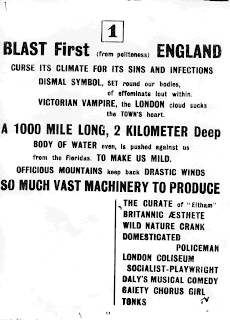
It seems hard to conceive, then, that Woolf did not know or hear about what was a remarkable and, ultimately, significant intervention on the stage of modernist aesthetics. However, nowhere in her diaries or letters for the period covering the two issues of
Blast! does Woolf make any mention of the magazine, or for that matter of Vorticism. She mentions Lewis and Pound only very briefly and tangentially. It seems odd that someone who was otherwise heavily engaged in the intersections of visual and literary art should be uninterested in a magazine which seems of its time quite important (if also self-important).
One reason for this gap might be that it is a wilfully cultivated ignorance, stemming from Woolf's antagonistic relations with both Pound and Lewis. In a letter of 1918 to Roger Fry, Woolf reports of her first meeting with Pound's protege, T.S. Eliot, whom she describes as a "strange young man." Their conversation got as far as discussing Pound, Lewis and Joyce, and whilst Woolf is inclined to agree with Eliot that the latter is a "great genius," she says of Pound: "Not that I've read more than 10 words by Ezra Pound by [sic] my conviction of his humbug is unalterable." Was
Blast! just another example of his "humbug," and so not worthy of mention?
Woolf and Lewis were similarly conflicted. Lewis had been prompted to develop Vorticism after falling out with Roger Fry, who had mentored Lewis at his workshop at the Omega gallery and who included Lewis in his second exhibition of post-impressionist painting in 1912. In 1914, feelings between Lewis and Fry were still raw, and Woolf's allegiances certainly lay with the latter, with whom she sustained a long correspondence and whose art theories influenced her later prose. Conversely, Lewis would later (in 1938) describe Woolf as "a sort of party-lighthouse," a symbol for the feminist movement but of exaggerated literary importance. So was Woolf allying herself with her friend by refusing to read
Blast!?
Both of these seem reasonable possibilities. The third option is that Woolf did in fact read or at least know of
Blast! but did not comment upon it explicitly in her letters or her diaries - hence why I have been unable to track down any mention of the magazine in her writings. However, the fourth possibility is that, not being a scholar of the modernist period, I may well be missing some glaringly obvious link or a reference to
Blast! or the Vorticists elsewhere in Woolf's writing. If anyone can get in touch to correct me, or to confirm that indeed Woolf either did not read or did not comment on this particular movement, I would be very grateful.
Labels: Blast, English Literature, Ezra Pound, Virginia Woolf, Vorticism, Wyndham Lewis
Review of Luka and the Fire of Life, by Salman Rushdie
Tuesday, August 07, 2012
My review of Salman Rusdhie's
Luka and the Fire of Life (2010) is now available to read.
This is a children's fantasy, adopting Rushdie's usual mode of magic realism. However, as a fantasy novel
Luka is unconvincing and undramatic, and although the novel has an interesting twist on magic realism as it is set within a computer game, Rushdie misses the opportunity to comment upon virtual culture in an insightful way.
The full review can be read here:
Luka and the Fire of Life.
Labels: English Literature, Game Studies, Luka and the Fire of Life, magic realism, Salman Rushdie
Fredric Jameson and the Gangster: Grand Theft Auto: San Andreas as a Cognitive Map
Thursday, July 26, 2012
My essay on Fredric Jameson's theory of "cognitive mapping" and
Grand Theft Auto has now been published in
Writing Technologies.
In this essay, I revisit Jameson's 1991 thesis from
Postmodernism, or The Cultural Logic of Late Capitalism, in which he argues that E.L. Doctorow's novel,
Ragtime, demonstrates how postmodern novels are generally unable to offer an adequate expression of the political currents of the time. Jameson argues that the problems of late capitalism can be better mapped through spatial representations rather than through text. Jameson does not clearly indicate what such a spatial representation might look like, other than suggesting it will be similar to postmodern architecture.
In my essay, I suggest that, today,
the narrative form of computer games such as Grand Theft Auto: San Andreas might offer a useful alternative model for some of the economic and social issues surrounding late capitalism, particularly those concerning race.
My thanks to the editor and reviewers of Writing Technologies for some helpful comments and patient editing, which led me to improve the article by including more game theory, at a time when I was only just starting to think seriously about computer game narratives. Also thanks to the attendees of the British Society for Literature and Science conference in 2010, who offered feedback on the paper which led to this publication.
Labels: English Literature, Fredric Jameson, Game Studies, Grand Theft Auto, postmodernism
Review of The Echo Maker, by Richard Powers
Saturday, July 14, 2012
I have just posted a review of Richard Powers 2006 novel,
The Echo Maker. Through exploring the psychopathology of Capgras syndrome, in which a patient mistakes a loved one for an imposter,
The Echo Maker offers a sustained meditation on the ways in which we project our own problems onto other people. As a reflection on the mysteries of consciousness, the novel offers some interesting if not especially new insights into the fuzzy boundaries between scientific and literary interpretations of the mind.
Although the novel won a host of literary awards, I am a little more sceptical about its value both as a novel, and as an exploration of the "two cultures" of science and literature.
The full review can be read here:
The Echo Maker.
Labels: English Literature, Science and Culture, The Echo Maker
Is the Political Novel Dead?
Friday, April 13, 2012
In a
controversial article that has been doing the rounds, Aditya Chakrabortty argues that by comparison with the India writer Rabindranath Tagore (whose 150th anniversary is this year) literary writers today have no time for politics. Where, Chakrabortty asks, are the Orwells, or Spenders, or Pounds of today? Perhaps only Arundhati Roy or Dave Eggers fall into the category of author-turned-activists that any rich literary culture should possess. English and American novels are, on the whole, "gutless."
The blame for this, he suggests, lies with the commercialisation of publishing and writing:
Literature too has been professionalised, so that authors now go from their creative-writing MAs to their novels to their relentless promotional work. Contemporary literary writers, it sometimes seems to me, are so tightly wedged behind their Apples that they have no time for politics. Unless you count signing the odd letter to the broadsheets as a political activity.
Perhaps it is an indication that Chakrabortty is primarily an economics journalist rather than a literary scholar, but I find his view naive.
Let us start with an obvious counter-example to his complaint above. The most prominent and respected product of the creative-writing academy that he so laments is the novelist
Ian McEwan, one of the earliest graduates of the famed
East Anglia MA. Virtually every one of his recent works has been a direct response to a political current.
Solar
(2010), for example, was an exploration of the environmental crisis. It may have looked, on the face of it, like an excuse for comic treatment, with its corpulent sexual buffoon, climate scientist Michael Beard, as its protagonist. But in fact the comedy is used as a vehicle to highlight the hypocrisy and double-standards that reside within the liberal community of scientists and literary intellectuals who are, allegedly, supposed to be most concerned about climate change. Remember, the inspiration for this work came from his experiences of the
chaotic boot room on the Cape Farewell project in the Arctic, and thus the book was an immediate outcome of McEwan's public "political activity."
Or take
Saturday (2005)

, a study of the uneasy climate in the post-September 11th era. Again, through setting the novel on the day of a protest against the Iraq war, McEwan engages directly with a contemporary moment. Through this, he exposes the hypocrisy of the anti-war movement, and the failure of the liberal intelligensia to escape from the ethical quandary in which preventing the war might also effectively licence the ongoing dictatorship of Saddam Hussein. Given that this observation might be expected to antagonise McEwan's natural audience, the liberal
Guardian reader, it was a strikingly non-dogmatic pose to strike. And, on this note, as with
Solar the novel can trace its roots back to an
article McEwan wrote just two days after the September 11th attacks for that very newspaper, in which he gave voice to the pained sympathy with which many of us viewed those images.
Or go further back, to
The Child In Time
(1987), which offers a caustic critique of the blind inequalities of Thatcherism, and a laissez-faire world in which everyone from children to tramps is under the assault of free-market ideology.
McEwan is of course only one example, though handily because of his background as a "professionalised" writer he offers an easy counterpoint to Chakrabortty's stereotype.
But I would take things deeper still in a critique of Chakrabortty, beyond any one novelist to the medium itself. The novel, I would suggest, essentially
is politics, right in its very bones. It is easy to forget that the novel is a comparatively new genre of writing, originating in the eighteenth century, alongside the scientific and economic enlightenment. Ordinary experience - which in the parallel scientific enlightenment would be labelled as empiricism - has equivalent interest in the sphere of art. The novel lets us see and feel the world from the point of view of other minds and bodies, something no other genre can achieve so directly.
Inherent to its generic abilities, the realist novel asserts that the quotidian and ordinary is as worthy of a sustained narrative account as the religious or epic. Of course, the cast of novels over the past three hundred years still includes its fair share of princes and heroes. But the novel also turns for its material to everyone else, from the
ordinary woman without good fortune who is in want of a husband to the merest
Pip of an orphan boy. From the
simple seamen of Conrad, to the
sons and lovers of Lawrence, from those who live across a
wide sargasso sea, to those symbolic
madwomen in our attics - the novel as a genre explores and evaluates the experiences of those who are aligned differently to the normal only by the merest fraction of a degree.
Sure, the characters of novels may not be political activists, world-changers; they do not always directly damn the establishment, make a clarion call for environmental responsibility, critique consumerism or hold a colourful banner up for a fairer life. But the idea that the life of the ordinary person is worthy of examination is perhaps the starkest and most profound political claim of all, the very definition of democracy. The idea that these mundane lives, too, are worthy of our empathy strongly contends that by extension the experiences of those who are dispossessed and marginalised must matter even more.
The novel may make these points only implicitly - but it is precisely the obliqueness of its argument that gives the novel form its power. The head-on collision of novels with politics often ends up as a noisy shouting match, held in the street for all to hear. The best novels slip their ethics in quietly, through the back door of what they do naturally. So quietly, indeed, that Chakrabortty has failed to notice.
Labels: English Literature, Ian McEwan, political novel, Politics
Can Literary Criticism be Crowdsourced?
Wednesday, March 28, 2012

They say that research and teaching should ideally be interrelated; so here's a research question for you that has been sparked by my teaching: can literary criticism be crowdsourced?

Before explaining how and why this question might be worth asking, a bit of background on where it comes from. Over the past couple of months, I have been doing a lot of close reading exercises with my OU students. For one module, I ran a discussion forum looking at a short, 20-line excerpt from Marlowe's
Doctor Faustus. The forum received around 100 different replies and ideas in response to it. Admittedly, many of my questions were leading ones: to ask students to find an example of enjambment and to say how this characterises Faustus implies that there is enjambment in the passage, and that it plays an important role in our perception of Faustus's mind in turmoil. Answers ranged from the superficial (as one might expect on this First Year generic arts module) to the spectacularly insightful. But what struck me was that across the full spectrum of 100 answers we really got to grips with the extract. Students picked it apart, noticed and explained things that even I - with a trained eye - had missed or not thought about.
At the same time as this was running, I was also marking my way through 60 second year essays looking at a particular passage from Wordsworth's
The Prelude. Again, some students spotted the same things that I had thought about when I looked at the passage. But others pointed out methods and approaches that I had not considered. After marking 60 essays on the same text, apart from wanting never to read
Wordsworth again (this effect being temporary, I hope), I felt that I had an astonishingly rounded idea about the way in which the language in the extract was working - a better idea than I, as a trained critic, had formed through my own close reading.
Which therefore leads on to my initial question: Can criticism be crowdsourced? Could a Wikicrit work?
Such a question, informed by a twenty-first century model of knowledge creation, would take us ironically back to the gestation of our discipline of English back in the early twentieth century. In the 1920s,
I.A. Richards argued that criticism should and could be seen as equivalent to a science. Through the proper training in literary methods of analysis, students and critics should be able to reach the "correct" interpretation of how a text (usually poetry) is functioning, and by extension to reach objective judgements as to its relative value compared to other samples of similar texts. As part of this scientistic methodology, Richards and the subsequent
New Critical school argued that extraneous conflicting variables ought to be removed. Students and critics should not be told biographical information about the author, since if one knows that a sonnet is by Shakespeare one might naturally be led to evaluate it more positively than if one knows it to be by Middleton. To prove his point, Richard used to
set his students a test, asking them to identify and evaluate various unattributed works by various authors ("good" and "bad") and to "comment freely in writing" upon them. He called this test, "practical criticism." Typically, students failed, spectacularly. In a letter, Richards wrote:
Oh strange beyond report, thought or belief, all the Candidates … with only one exception prefer Mrs Wilcox [who provided the really worthless piece] to Landor, Hopkins, Belloc, De Quincey, and Jeremy Taylor at their very best!
Despite these perceived failings, Richards' 1929 book on
Practical Criticism which emerged from the experiment cast a long light (or shadow, depending on your views) over the discipline. To this day, the rebranded "close reading" forms an integral part of literary courses.
The influence of practical criticism has not gone unchallenged. Historicists would argue that to treat a text as if it is hermetically sealed from the culture which produced it is naive. We can only properly understand Shakespeare if we understand the conditions of Renaissance theatre and the Elizabethan court in which he was writing. Political forms of criticism (Marxism, feminism) have taught us that we always read from a prior ideological position, such that stripping away the marks of authorial identity from a poem is only to remove the tip of the iceberg. The deeply ingrained cultural presuppositions still lie beneath the surface and support the way in which we read. Indeed, Richards himself aknowledged that "The precise conditions of this test are not duplicated in our everyday commerce with literature."
But whilst we should be aware of the inherent artificiality of the "close reading" methodology, a crowdsourced practical criticism might still be productive. My students had been taught about Marlowe's life and works, and Wordsworth's relationships in Romanticism (indeed, the latter was vital to a full understanding of the set passage, given that in it Wordsworth was addressing an unnamed "friend," who we can deduce was Coleridge). They were thus to a certain extent reading through a historicist lens.
However, when running my discussion forum and marking, I noticed that over the course of 50 to 100 comments on the same piece, these issues balanced out to their proper proportions. If I was editorially to represent the range of arguments and ideas in a summary essay, I would have certainly introduced issues of context (Marlowe's performance possibilities, Wordsworth's links with Coleridge); but for the most part I would have drawn attention to issues of form and literary method, issues that any single person - myself included - might have missed. Students were not asked to evaluate whether they thought the passages were relatively good or bad - and in any case most would have noticed that the fact that they were on university syllabi naturally implied the former - but I suspect that had they done so, I as "editor" would have found views coming down democratically on one side. Some "practical criticisms" may have been outliers. However, by the end of the two exercises I had a reasonably firm view of a consensus about how the language was working. The "crowd" had achieved a solid, crowdsourced, practical criticism - and one in which ideological prejudice would have been reduced by the sheer quantity and diversity of respondents.
Of course, that word "editorially" that describes my position implies that a crowdsourced criticism would not, after all, be doing much new. What does a single scholar do when they begin a new project? He or she reads and assimilates a wide range of existing critical views on the subject, to triangulate and form his or her own opinion. Before they can write, first they must understand what the existing consensus is. However, there is still a sense in which the single scholar tries to come up with their own view in opposition to the mass - after all, there is no point producing a work (other than for textbooks) that simply recapitulates existing views. By definition, in order to be published scholars must contribute something new to the field.
Clearly, a crowdsourced practical criticism would not be able to contribute something new in this sense; it could not put that text into context or relationships with other works by the same or other authors, which is what most professional scholarship is about. I am talking about crowdsourcing close reading of individual texts. Such a model of multiple anonymous authorship might be an efficient - perhaps even more efficient - way of doing this type of niche, microscopic criticism. One of
Wikipedia's "five pillars" is:
We strive for articles that document and explain the major points of view in a balanced and impartial manner. We avoid advocacy and we characterize information and issues rather than debate them. In some areas there may be just one well-recognized point of view; in other areas we describe multiple points of view, presenting each accurately and in context, and not presenting any point of view as "the truth" or "the best view".
The risk of individual scholarship is precisely that the one scholarly view is presented as being the "best view" or "the truth," when of course with literary texts do not sustain single interpretations, much though the discipline may adopt scientistic ideals of objectivity. A crowdsourced criticism would remind us of the multiplicity of interpretations - Wikicrit would always be subject to new additions or alterations - whilst at the same time it could perhaps arrive at a more insightful reading of a text than any one reader (professional or otherwise) could attain.
Labels: English Literature, I.A. Richards, practical criticism, Wikipedia


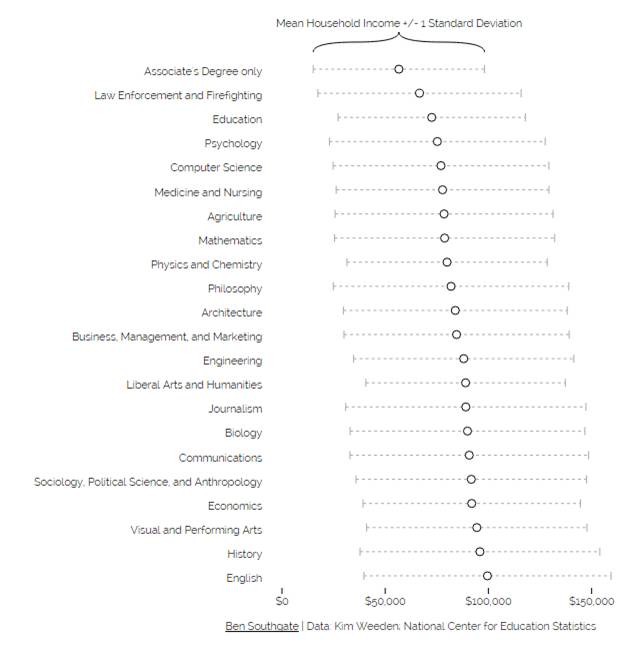


 It seems hard to conceive, then, that Woolf did not know or hear about what was a remarkable and, ultimately, significant intervention on the stage of modernist aesthetics. However, nowhere in her diaries or letters for the period covering the two issues of Blast! does Woolf make any mention of the magazine, or for that matter of Vorticism. She mentions Lewis and Pound only very briefly and tangentially. It seems odd that someone who was otherwise heavily engaged in the intersections of visual and literary art should be uninterested in a magazine which seems of its time quite important (if also self-important).


 |


