Videogames and Literature: Achieving Interdisciplinarity (Seminar on 15th November)
Wednesday, November 02, 2016
If you happen to be in Durham on 15th November, I'm giving a seminar on video games and literary studies, as part of the new
Digital Humanities Durham series. This is going to be quite a polemical discussion, outlining where (as I see it) literary scholars have got things wrong about video games - and how we can start to put things right. It may be of interest to anyone looking at histories of literary theory, video games, and theorising the difficulties of interdisciplinary or intermedial studies more generally. Abstract is below; more details
here.
Abstract
On the face of it, the ways video games and literature tell stories may seem to be very different: video games are multimedia and interactive works, whereas literature is largely text based and plotted in a way that is predefined by an author. Nevertheless, in the 1990s literary scholars were among the first to incorporate game studies within the university context, colonising games on behalf of the discipline of English. Like all colonisations, though, the trading partnership was one-sided; early English scholars were keen to show what they could do for games, but less interested in what games could do for literary scholarship. While the digital humanities in general have seen digital practices radically reshape the methods employed by the humanities, an archaeological study of literature and game studies will uncover few attempts to consider how the study of video games might teach us to think differently about traditional literature itself. This talk will illustrate how literary scholars can modify their practices and methodologies, treating interdisciplinarity and intermediality as a two-way exchange of knowledge and ideas between video games and literature. In particular, it will show how game theory can be applied back to literature, and will demonstrate how the development of game adaptations of literary texts could provide a means of literary critique.
Labels: interdisciplinarity, intermediality, literature, theory, video games
Ready Player One
Tuesday, March 31, 2015
As I have been doing the rounds of conferences and workshops, and nattering on about video games and literature, people have repeatedly told me that I should read Ernest Cline's
Ready Player One. So, since I'm now enjoying the vacation (or what passes for it), I just have.
If you know your 1980's pop-culture and have fond memories of joystick bashing in coin-op arcades, you're probably going to find it an enjoyable romp, viewed through the dayglo spectacles of retrospect. The novel's plot is a rudimentary quest narrative, focusing on a hidden prize that lurks within the game world of the Oasis, which is a kind of mashup of various online role playing games. To discover the lucrative reward, players such as our hero, Parzival, need to have an intimate knowledge of the geekish 1980's obsessions of Oasis's programmer, Jim Halliday (a thinly disguised version of Steve Jobs or Bill Gates).
As a consequence of this structure, every page hums with intertextual knowingness: when you spot that a line of dialogue is lifted from
Back to the Future, or recognise the in-joke about the
Dungeons of Daggoroth, of if you already knew that you could pause
Pac Man by nudging him into a corner, you'll get that little buzz of pleasure that comes from being on the same level as the author. It's not surprising that the book has become a hit, appealing to an age when every cult film and video game has its own Wiki, and trivia is the currency of Buzzfeed and Reddit.
Yet in terms of literary style, the novel's constant referentiality becomes a bit wearing. None of the characters have deep, carefully delineated personalities. Instead, they are like pixellated mosaics assembled from pop cultural icons, as in:
My surroundings made me feel like I was in a low-budget sword-and-sorcery flick, like Hawk the Slayer or The Beastmaster.
Or
Roaming the halls unnoticed, I decided that I enjoyed having a secret identity. It made me feel like Clark Kent or Peter Parker.
It's tempting at this point to adopt the schoolmasterly voice of the
New York Times reviewer: Mr Cline would do well to learn that simile, if used repeatedly, does little more than draw attention to the artificial contrivance of the connection. What do we learn about the feelings or mind of our hero here, other than that (like that of his author, presumably), it's full of "stuff"?
At least these are evidently
just analogies, though. With some of the descriptions, it's hard to be sure whether Cline is being ironic, or hyperbolic, as here, when Parzival suddenly deciphers the first clue:
And that was when it hit me. Like an anvil falling out of the sky, directly onto my skull.
Thinking hurts, admittedly - but rarely this much. Is this a self-mocking homage to cartoons? Or just untempered exaggeration, the novelist's equivalent of typing with caps lock on? (It's that pedantic "directly" that really narks me, as if cognitive anvils might occasionally fall from the sky but slightly miss their target.) The problem, beyond the aesthetic, is that such descriptions flatten the difference between ordinary existence, and the exuberant variety of the game world. Cline's characters exist in a constant sensory overload, whether they are being assailed by anvils in the mind in real life (IRL) or by blasters shooting at their avatar bodies (in the game).
In the best cyberfiction, the fact that there is still a separation between real and virtual is all important. It's what the virtual can tell us about the real that gives cyberfiction its political edge, and elevates it from being "just" genre fiction. William Gibson's
Neuromancer, for instance, treats cyberspace as both a zone of futuristic speculation, and a reflection on the structures of capitalism in his immediate present, the real.
This metaphorical distance collapses in
Ready Player One. Beyond a sparse description of "the stacks" - a kind of vertical trailer park in which Parzival lives when the novel opens - and vague references to global warming and an energy crisis, we get very little sense of what the real world is actually like, such that the Oasis seems neither a departure from the real, nor an aslant criticism of it.
Which would still be fine, actually, if the whole point of the novel was precisely to suggest how indistinguishable and conflated the two realms, the real and the virtual, have become in our ludic twenty-first century.
The Matrix, for example, asserts (following Baudrillard) that everything is simulacra. While this seems bizarre, its moral about the possibility of believing in a computerised virtual reality is ironically conveyed through something that is itself a simulation (a digital film) that is completely immersive. It proves its point through its own aesthetic. If
Ready Player One were to do something similar - to so seduce us into its fictional realm so that we are forced to recognise our own genuine capacity to be deceived by the virtualisation of reality - then that would be interesting. However, Cline's writing style is always a step removed, somehow commentating on itself in the process of composition so that we can never inhabit its world as fully as its characters inhabit their games. Here, for instance, is Parzival, whose best friend in the game plays as a man, but who turns out to be a woman in real life:
Aech had selected an RX-78 Gundam mech from the original Mobile Suit Gundam anime series, one of his longtime favourites. (Even though I now knew Aech was actually a female in real life, her avatar was still male, so I decided to continue to refer to him as such.)
Being so obviously an address to the reader - in a science fiction which otherwise concentrates on building another, convincing world - it breaches any conviction we might have in the novel's alternate reality. It's like one of those dull but necessary footnotes in an academic textbook, that announces that henceforth future references will be abbreviated.
In fact, a textbook rather than cyberfiction is perhaps the genre to which
Ready Player One is best fitted. One emerges from it feeling one knows a lot more about obscure 1980s video games than one did before - and realising that one has probably seen
Back to the Future a few more times than is healthy. Take it as a test, enjoy playing the game - but go off and read some better cyberfiction afterwards.
Labels: cyberfiction, Ernest Cline, Neuromancer, Ready Player One, video games
Games Like Television Like Games
Friday, August 08, 2014
Keith Stuart has written a
perceptive article on how EA Sports' Fifa series of video games has developed increasingly like-like degrees of realism. The new 2015 iteration promises faithfully to model every Premiership ground, right down to capturing the unique noise and chants of crowds over the audio commentary, with camera angles and replays that reflect the positions of television cameras in the actual stadia. As Stuart points out:
Just as Sky exploded into football coverage in the early nineties bringing video game-like stats, sound effects and visuals, video games have met the television industry half-way. A match in Fifa 15 will begin with a stadium fly-over cam, the Premiership theme tune, the players lining up to shake hands, the commentators gabbing on about the meaning and important of it all. You can click through it all, but gamers are encouraged to feel a part of the “theatre”.
In this way, what is being emulated in the Fifa series is not simply the sport, but the narrative of the sport as disseminated via television. It is a good point, and one that we can extrapolate to other games as well, which do not render the original experience but the experience as already rendered through other media. Think, for example, of the cinematic quality of
Call of Duty, which takes its cue not from war itself but from movies like
Saving Private Ryan. What is aimed for here is not a pure realism, but a realism of the simulacra. Like Baudrillard's Disneyland, the mimicry of the event supersedes the original in its presentation and quality.

However, perhaps the more interesting observation to take forwards, which Stuart only glances at in the quote above, is that the traffic is two-way. Games do not just take their inspiration from television and cinema, but the latter media also draw on the theatricality of games. Thus both Sky and BT Sport's football shows increasingly invite viewer interactivity, through social media, live betting, and smartphone apps. Digital television allows the viewer to choose his or her camera angle, including following one particular player closely through a match, not unlike the experience of the simulation. Even the conservative
Match of the Day has a three-dimensional replay mode, whereby commentators can spin around a virtual image of the live action, much like replays in Fifa. Whilst we still tend to conceptualise games as a sub-culture, the influence of games on our most popular sport and a mainstream media reminds that the ludic cannot be boxed off from other narrative methods.
As
Matt Hayler observed in a brilliant conference paper recently, technologies change the types of aesthetic that it is possible for us to conceptualise. He cited the case of "robot" break dance (witness footballer
Peter Crouch, or better still
this example), a performance whose semiotics would make no sense in a culture without robots and mechanical devices; similarly, this
light dance evokes early video games, the film
Tron, and our ability to discriminate a continuous performance despite lights flickering on and off, to which video technologies such as fast-forward have attuned us (indeed, after his paper I mentioned the example of Martin Amis's
Time's Arrow, whose backward narration would not be conceptualisable before the era of the video recorder rewind). Tracing this thread, then, I think one can make the case that it is not simply that video games have sought to emulate television-style commentaries, but that the presentation of sports on television is designed increasingly to resemble a video game.
Of course, unlike the video game, we do not actually have control of a televised game. The game-style of contemporary sports commentary is designed to enhance the illusion that will sustain all football fans over the coming season: the belief that by shouting loudly at the television they can actually influence the action.
Labels: fifa, sports, television, video games
New Publication: The Computer Game Fallout 3 as a Serial Fiction
Tuesday, July 29, 2014
The edited collection
Serialisation in Popular Culture has now been published, including an essay of mine on "The Video Game
Fallout 3 as a Serial Fiction." Here is the abstract:
Although computer games and literary narratives use different narrative both media compel players and readers in similar ways through the "sense of an ending," a concept that draws on the work of Frank Kermode. Serial fictions especially must balance between giving readers unexpected twists at the end of each installment, and an ultimate sense of conclusion. Computer games therefore resemble serial fictions because they tease players as they progress through levels (or installments). Games push players down false routes or into unexpected failures in order to make the satisfaction of an ultimate conclusion more pronounced.
Since writing this chapter, based on a conference paper three years ago, I think I've probably become more hardline in relation to the theoretical underpinning for this piece. In particular, I am less inclined than ever to see literary narratives and video game narratives as structurally similar. Indeed, as I point out in the chapter, although video games might seem like serial fictions at a material level, in that they encourage players to download additional content and mods to prolong the story, even this comparison does not really hold, since video games do not require players to pursue these additions, whereas the whole point of serial fiction is that reading the next installment is essential to understanding.
Nevertheless, even if their narrative structures and techniques are different, I am more convinced than ever - based on some of my later research - that from a phenomenological point of view both games and literary texts elicit similar reactions in their 'readers', and seek to produce similar forms of pleasurable engagement. In this case, I draw on Kermode to show how we read and play for the sense of a certain ending that we are denied in our everyday existence.
My thanks to the editors, Rob Allen and
Thijs van den Berg, for producing a really diverse collection, which rightly examines the ongoing influence of serialisation beyond its alleged Victorian heyday and into the twenty-first century. (Incidentally, for those readers who are especially interested in video games, the latter has written one of the best
essay you're ever likely to read on how video games (such as
Bioshock) encode capitalist ideology.)
Labels: Fallout 3, publications, serial fiction, serialisation, video games
Can We Measure the Degree of Agency in a Video Game?
Friday, July 18, 2014
In her book
Hamlet on the Holodeck, Janet Murray speculates about the importance of agency in digital games. It is agency, the participation of the player in the shaping of the narrative, that differentiates video games from literary texts. Agency, she writes, "is the satisfying power to take meaningful action and see the results of our decisions and choices." The key term in this definition is "meaningful." Action alone is not agency. As Murray points out, in a game of chance, for example, a player may perform lots of actions: rolling dice, moving pieces, spinning tops. However, a player has no agency since these actions are not meaningful in the sense of shaping the course of events, which are instead determined by luck. In a game of chess, a player may make fewer actions, but each action is more meaningful since it alone, and not luck, potentially affects the outcome of the game. In a game like poker, there is a degree of chance, but a skillful player has high agency because by strategising effectively he or she can mitigate the influence of the precise cards they are drawn.
Determining the degree of agency in these examples is pretty straightforward, and ought in principle to be quantifiable. However, to what extent can we quantify the degree of agency a player has in different video games?
In some, such as
Candy Crush, one can envisage the degree of agency being quite low. Whilst there is some degree of strategy, the game is weighted most by luck - which is why it can be so infuriating to play, and so entices players to purchase bonuses which will increase their chances, such as by adding more moves. The emphasis is on repetitive action, that is eventually rewarded.
In a game like
Skyrim, on the other hand, the potential for agency seems enormous. In a massive environment, we seem to have complete freedom of movement and choice. As Murray suggests, "The desire for agency in digital environments makes us impatient when our options are...limited. We want an open road with wide latitude to explore and more than one way to get somewhere." Exploration is the name of this particular game.
Somewhere between these poles might be on rails shooters or platformers. We have some degree of freedom, but are largely driven down prescribed paths. The trick of game design is all about giving us the illusion of choice.
Yet this is where agency becomes a highly problematic means of measuring the openness either of a game world or of a game's narrative. Take something like the recent
Tomb Raider. This is a very cleverly designed game world, presenting itself as a vast explorable island, when in fact the player is funneled down particular pathways. Compared to
Skyrim, our agency would seem to be limited - though still of course very substantial, far more so than a game like
Candy Crush. However, at times the game interactions narrow to a binary state with set-piece interactions - for example, a wolf attacks us at a scripted position in the game world, and we must follow the on screen prompts to press the appropriate two or three keys. The outcome is binary, either we live or die. What, then, is the degree of agency here? On Murray's measure of agency as "the satisfying power to take meaningful action and see the results of our decisions and choices," this would seem to be a moment of high agency - perhaps even higher than the explorable game world despite being less open. These actions are intensely meaningful: they determine whether we will live or die, unlike our normal actions which allow us a degree of failure (lost health) before dying. This is why they come across as intensely satisfying, dramatic experiences in which we seem genuinely to have protected a fragile heroine. In the more open exploration, by contrast, Lara seems to be able to take an unrealistic amount of damage and in some ways is less in need of our protection.
Whilst the narrative of
Tomb Raider perhaps channels the highest degree of agency through the narrowest of funnels, in
Skyrim whilst we may well take pleasure from the freedom of exploration, the degree to which our explorations serve to affect the course of the narrative in any meaningful way is questionable. A game that seems to be of high agency may not actually be so. Certainly, the more we explore the game world the more likely we are to enhance the skills and equipment needed to advance the quest more easily. However, except in very limited ways (such as the civil war questline) our choices do not affect the ultimate narrative that we pursue.
What these problems suggest, I think, is that agency as it pertains to traditional games is a very different measure to agency in video games. The difference is that in the former, the degree of agency is dependent upon the amount of chance inbuilt into the game system. In a game that depends entirely on chance, such as the role of the dice, there will be no agency. By contrast, no video game that I can think of depends wholly on chance. As such, agency itself is immeasurable. Neither does agency correspond to the open-worldness of a game.
Tomb Raider may have moments of higher agency when the world is actually more closed down, whilst
Skyrim may seem a high agency world when in fact our actions are not necessarily meaningful in relation to the narrative. In a way, because the world is so open it gives us the chance to pursue actions that are meaningless, at least from the perspective of the game itself (from the point of view of the player, of course, even non-narrative advancing actions like crafting or taking a wander through the woods can still be meaningful, enjoyable experiences).
Agency, then, seems to offer a very limited means of measuring video game construction. Certainly, the reason we take pleasure in video games is that we perceive ourselves to be shaping the narrative and affecting the outcome of as-yet undetermined events - in this sense it is unlike the process of reading a novel. However, the extent of this shaping is always limited, not as in traditional games, by chance, but rather by the designed nature of the game world.
Labels: agency, narratology, video games
Are Video Games Literature?
Wednesday, August 21, 2013
I'm pleased to have contributed a guest post to
Oliver Tearle's excellent
Interesting Literature blog, in which I give a general overview of some of my current thinking about games and literature. It's a little bit provocative, but hopefully also stimulating. Here's the first paragraph to pique your interest:
To ask “Are video games literature?” seems a pointless kind of question, like pondering whether a film is the same thing as a poem, or whether a Rembrandt painting tastes like cheese. Yet asking this question is a necessary provocation, because it helps us to think about how and why video games and literature might elicit similar reactions in their players or readers, even if they set about this process in quite different ways...
If you want to read more, head on over to
Interesting Literature.
Labels: English Literature, video games
On Crime in Video Games
Thursday, August 15, 2013
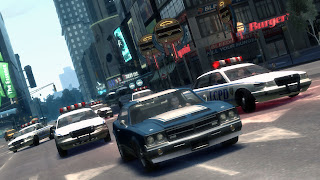
Phil Hartup's latest post for the
New Statesman offers a
review of some recent heist games, such as
Payday 2. In passing, he makes a comment which I want to interrogate more deeply in this post.
"Theft," he observes, "occupies a curious place in the moral pantheon of video games in that it isn’t really considered wrong to steal in most games." As he points out, most game worlds have been set up for the player's disposal, and very few offer penalties for thieving or taking objects, coins, food, and other ephemera from chests, cupboards, the floor, or wherever else loot happens handily to be lying around. Hartup points to an important and interesting structural principle that underpins most games (with the possible exception of puzzlers, strategy games, and simulations).
Take something seemingly innocuous, like
Super Mario.
Super Mario presents a world in which objects are favourably placed for our exploitation. Hit your head on a box, and whatever comes out is rightfully yours. Spot a magic mushroom, and you can gobble it up. Find a coin, put money in thy purse. In the real world, we would not presume if we came across at £10 note that the money was automatically ours. Yet in the game world, the innate presumption is that anything that is out there in the world is in the commons, ripe for public consumption - the public in this case being a public of one, me as the player. Indeed, this presumption is coded very deeply by the fact that
without taking, most games would be impossible. Extra lives, health packs, coins, or other icons offer an internal "currency" which we must then "spend" at key points to progress.
Of course, some stuff in the game world is not in the commons, but owned by enemies, who drop it when killed. Here too the presumption is that anything that attacks us is at our disposal. We can defeat it and, having defeated it, take all its worldly goods. It is a behaviour that is so unconscious and instinctive that it almost goes without saying, yet it is actually interestingly different to our unconsciously coded behaviour in the real world. If we are attacked or threatened on the street, we presume our right to defend ourselves with reasonable force. But we do not presume that we then have the right to take whatever possessions that individual owned, even if the reason for the original confrontation was to try to thieve from us. An eye for an eye applies in an absolute ratio in the game world, but not in our own. Thus behaviours in the game world are licensed as normal - indeed, are essential to success - that would be considered abnormal or antisocial in our reality. Hartup is right, then, to note that crime and immorality are at the heart of the gaming mechanic.
On the other hand, as they become more narratively complex many games have begun to draw our attention reflectively to this problem, and to make themselves more correspondent to our real-life moral codes. As Hartup notes, in role playing games such as
Fallout 3 or
Mass Effect, a karma penalty is applied when players steal. This affects, often with quite serious consequences, the way non-playing characters behave towards the player; for example, shopkeepers may refuse to sell essential goods to a past thief.
Sandbox games, too, typically have some sort of mechanic for crime. In
Skyrim one can be locked up for stealing. Such mechanisms are, indeed, often imperative in sandbox games, which in principle allow a player free reign - but which must in practice constrain or nudge the player down certain pathways. For example, picking the lock of a particularly dangerous castle might give the player early-game access to high-level loot that would make playing the later game an unbalanced and dully easy affair. Thus the consequences of picking that lock may be that a particularly large number of guards will come running and almost certainly arrest the player, or mete out summary justice by killing them.
Here, though, there is something of a paradox that again distinguishes the structure of game morality from that of the real world. To be pursued by the law in reality is to undergo something subversive and problematic: we run because we have done something that we know is wrong, we live in fear of the consequences if we are caught for our past misdemeanours. Though I have never been worried by the law myself, I presume it is not on the whole a pleasant experience (though for some, joyriders for example, it may be exhilarating).
Yet even in a game world which has systems of justice, these systems are not entirely punitive. For in the game world, running from the law often entails fighting, evading, navigating mazes - exactly the same mechanisms that are involved in abiding by the (game) law in order to complete a quest or pass a level populated by enemies. Being punished by the law thus facilitates player behaviours and thrills that are on a par with the processes and aims of play that are considered normal and "good." Whether being good or bad, the net experience is very similarly rewarding.
Hartup is right, therefore, to wonder, "if thievery is par for the course in gaming where does that leave the heist game?" The troubling answer is: not much different from a moral point of view. Many critics have seen the likes of
Grand Theft Auto, in which breaking the law is key to the game, enjoyable and rewarded accordingly, as worrisome because it seems to present antisocial and immoral behaviours as acceptable. Players then carry these behaviours over into the real world. However, on a deeper, structural reading of games we can see all games as rewarding crime - something that presents a much bleaker picture. Breaking the law and evading the justice of the good guys, and abiding by the law and meting out justice to the bad guys, are two sides of the same coin. They both satisfy our itchy trigger fingers.
Labels: justice, law, morality, video games
Lara Croft, Feminist Pioneer?
Friday, June 28, 2013
Researching for a conference paper on Lara Croft for the
Literary Dolls conference, I came across (via
this report) a remarkable statistic from the game-industry research centre, EEDAR. Out of 669 current titles that had protagonists of a specific gender, only 24 of these were exclusively fronted by women. These titles sold less well than male-led games, because they received less marketing. Given that
45% of all gamers are women, and given that the average age of gamers is a mature 30 rather than a hormonal 16, this is an even more surprising gap.
When I started writing my paper, I was attempting to reject the automatic presumption that hyperbolically sexualised protaganists, such as Lara Croft, should be condemned. Or, rather, although I think such depictions
are a problem in gendered terms, we need to think about more than just the sexual politics that went into their making. My paper calls for us to adopt a
ludological perspective on Lara Croft. We can't just consider the representation of her gender as being a consequence of patriarchy, a role play which (following Judith Butler) demonstrates via the extreme how women should perform in reality. Rather we must consider the reasons why from a mechanical point of view such a representation might, to some extent, be necessary to the process of the game. For example, Lara's long legs are essential to navigate realistically the challenging environment that the designers have constructed. Furthermore, in the process of playing male gamers ironically occupy a female point of view, and the game's risk-reward structure is intended to reward gamers who actively seek to protect Lara and control her body in a sympathetic way; it punishes gamers who simply stand still and "gaze" at her (yep, rolling out the feminist big guns there's some Laura Mulvey in there as well).
Video games are complex, interactive media objects which operate according to a unique set of rules and codes. We cannot simply flatten a game and say that because the two-dimensional image of women that it depicts is biased or patriarchal, it therefore recapitulates gender constructions in exactly the same way as film, or the
Daily Mail sidebar of shame.
However, these industry figures on female protagonists give a different slant to the issue. Is there a case for saying that, given the dearth of female characters in video games,
any representation of the gender, no matter how hyperbolically sexualised, is a good thing? This is, of course, a parallel debate to that had in other areas of culture. Is it good that Katie Price has become a media mogul through exploiting her body? Should lap dancing be seen as a legitimate means of female empowerment?
Put bluntly, is the fact that players spend hours staring at Lara Croft's pert ass a good thing, if it means that at least such (male) gamers are playing a woman in the first place? Is it necessary to break ground through confirming to patriarchal desire, so that it can eventually be subverted? I'm not sure, and this is something of a tangent to my research (hence blogging about it). However, given this remarkably low starting point with so few female leads, it will be interesting to see how gender depictions play out in the new media of video games in years to come.
Labels: feminism, Game Studies, Lara Croft, Tomb Raider, video games
Are Video Game Narratives Postmodern?
Monday, May 13, 2013

I have a new article out in the
Alluvium journal. In "
Are Video Game Narratives Postmodern?" I ask about the best way to categorise video games amid the hangover of the postmodern period. Are games naturally postmodern narratives because they develop interactively? Or does a label, such as "postmodern," lose its usefulness when it applies across such a broad spectrum of activities and cultural products?
I've noticed increasingly that cultural critics, who are usually very discerning when it comes to distinguishing realism from modernism in literature, for example, or minimalism from expressionism in the visual arts, are happy to lump games together as examples of postmodern phenomena simply because game narratives happen to be interactive and unpredictable. In this article, I challenge this presumption, and suggest that there is no one way to box games generically. Indeed, to my mind even "games" is an misleading description of the various types of activity that might come under this rubric, from a sports simulation to a puzzle game to a narratively driven representation.
This article has its origins in this blog post on
gaming and literary genres, which demonstrates statistically how hard it is to label games according to one particular theory. The unique thing about games is that the medium and mechanism of representation determines the message to a very great extent. A game which is allegedly "postmodern," or "realist," or "minimalist," or whatever other aesthetic label we may want to transport from fields such as art and literature, may actually be so due to the technical platform on which a game runs: no ZX Spectrum game could ever be much other than minimalist.
Anyway, I start to digress into other fields of enquiry, so for now, head over to
Alluvium and read the
article in its entirety. As ever, many thanks to
Caroline Edwards for editing and glossing with some well-chosen pictures, to
Martin Eve as online editor, and to all those who have posted kind early comments on
my Twitter feed this afternoon.
Labels: Game Studies, postmodernism, publications, video games
Video Games, Videogames or Computer Games?
Sunday, April 07, 2013
I have been having a relatively productive Easter writing two articles, one forthcoming in
Alluvium (watch this space) and another on the representation of ageing in video games (about which I'll say more in a future blog post).
As I have been doing this, I have been thinking about the problem of terminology for what is still a relatively young discipline. When I first published on the topic three years ago, I made reference throughout to "computer games" throughout my
book chapter. Writing my latest articles, I have noticed myself using "video games" and "videogames" interchangeably. Which is the correct term to use?
This is more than just a stylistic nitpicking of which we literary scholars are so fond. We need to agree upon a common term so that information is easily findable in journals and books, with metadata used consistently.
The pre-eminent journal in the field,
Game Studies, describes itself as a journal of "computer game research" but the articles within it adopt "videogames," "video games" and "computer games" more or less interchangeably. Because of this variation, I have to maintain three Zetoc alerts for the three main search terms - and even these may not be sufficient, if articles happen to use more idiosyncratic phrases such as "digital games."
I have done a Google Ngram query (for "
video game, videogame, computer game") which confirms my hunch, based on my general reading, that the most commonly used term today is "video games." The phrase "computer game" begins to tail off around the year 2002. The word computer is roughly synonymous with the desktop personal computer, but of course the last decade has seen a shift away from the desktop so that the major platforms now are laptops, tablets, mobile phones, and game systems such as the Xbox. "Video game," by contrast, has risen in popularity, so that today it is used roughly three times more than "computer game." On the majority vote, "video game" seems to be the term to use. It is also the more logical, since "computer game" implies games that run on computers, a term that most people would not apply to the likes of smartphones, which are an increasingly popular gaming platform.
Labels: Game Studies, video games
Gaming and Literary Genres: Some Thoughts
Wednesday, December 12, 2012
On
Reddit, a new chart offers a useful visual typology of video game genres (shooter, RPG etc.) and platforms (Sega Megadrive, Xbox etc.).
Scraped from a historical database of 24 000 video games, the chart provides at-a-glance confirmation of significant historical changes, such as that text-based adventures peaked around the mid-1980s, and have declined to virtually nothing today. Strategy games have been more or less consistent throughout the last thirty years, whereas scrolling shooters have gradually decreased in popularity. The latter genre was common in an age when hardware could only render two-dimensional graphics, but has been supplanted by three-dimensional action shooters now; strategy games, by contrast, could evolve and adapt across different platforms because they are less dependent on graphics.
This chart of generic trends will no doubt be poured over by game historians. However, in keeping with my
current research project on
Reading Games: Computer Games and the Limits of Literature, I want to think - very hypothetically and off-the-cuff - about how literary themes and genres might map onto game ones, and vice versa.
The first thing to note is that there is a potential correspondence between game platforms and the main literary modes: novel, short story, drama, poetry. As
Jesper Juul points out, platforms are less subject to changing interpretations: an Xbox game will not run on a SNES. In much the same way, the novel, drama and poetry are on the whole easily discriminated. A novel is generally not mistaken for a poem, or a play for a short story. Of course, there are some interestingly fuzzy edges. Is an extract from verse drama capable of standing alone as a poem? How long does a short story have to be before it becomes a novella, or novel? By and large, though, our definitions of these forms are fairly robust. The similarity between games and literature is possible because the criteria of "platform" is determined according to the physical media on which meanings are produced, not how those meanings are styled.
The major difference, however, is that game platforms are far more diverse and fragmented than writing "platforms." The chart includes 34 different gaming platforms, ranging from the mobile phone to the ZX Spectrum to the PC. Novels may come in all shapes and sizes, but we would not say that a cloth-bound text is a fundamentally different media to a softback, because most of the significance of the text is embodied in the story it communicates and not in the medium it uses (although interestingly the rise of the ebook and hypertext may be shifting our preconceptions about this).
At a quick glance, I would guess that a similar pair of charts for literature would show inverse trends to that for games. The chart for literary "platforms" (novel, poetry etc.) would have relatively few different colours, and thus would look more like the chart for game genres which has just 14 separate strands. The chart for literary genre, by contrast, would be massively chaotic, looking more like the chart for game platforms which has 34 different colours. In gaming, then, it is the platform - or medium of production of meanings - that is more variable than genre.
Certainly, within literature, it is when we get to the level of genre rather than "platform" that things become most messy. It is relatively easy to distinguish a play from a novel, but somewhat harder to distinguish a satire from a comedy, or a mock-epic from satire, or parody from farce. Labels of genre are notoriously slippery. Postmodern literature, indeed, brings these conflicts and overlappings to the foreground of the text. As I recently noted in
this essay, contemporary works like China Mieville's
The City and the City or Kazuo Ishiguro's
Never Let Me Go are fascinating because they seem intuitively to be science fiction, but as soon as we start to try to put our finger on the conventional technological imaginaries that are inherent to the genre we find they are not there, and their "proper" genre remains elusive.
A critic of the game chart could perhaps argue that such a mess should also be apparent here too, but that the chart is instead artificially uniform. Are there really just 14 or so different game genres? One could certainly argue about the categorisations used here, which are necessarily subjective. For example, when does an arcade game - which on this chart is a consistently dominant genre - become an action adventure? Many people would identify
Space Invaders as an arcade game, by virtue of the physical space in which it was played in the 1980s, namely amusement arcades. At this early stage of game history, genre is quite correspondent with platform, as is epitomised by the use of the term "arcade" as both a genre and a platform. However, if updated today
Space Invaders would probably manifest itself as a space-based shooter framed by other elements of play; it would no doubt allow a player to interact with other characters, with missions embedded within an ongoing story. Does this make it an arcade game, an adventure or an RPG? Even another early game like
Elite could be said to be all three at once.
So out of this chaotic and colourful pattern of genres and platforms, are there any useful questions that can be asked?
From a culturally materialist point of view, the interesting issue to explore is the degree to which genres and the medium or platform on which they are produced are interlinked. Marxist critics of the novel such as Ian Watt or Raymond Williams contend that the novel arose at a time when printing had become widely available and affordable. It catered to the tastes of a newly middle-class reading public, and as a consequence the genre that is most closely associated with the novel is realism, the depiction of comparatively ordinary life, as opposed to heroic or epic romance that had been the preserve of poetry, which was disseminated orally or via song to courtly audiences.
Despite the diversity and fragmentation of game platforms, it is not hard to figure out that a similar relationship between medium and message will apply here. For example, the sudden growth of mobile gaming on the iPhone or iPad (which in this chart provides around a third of platforms) is surely an explanation for the sudden spurt in the puzzle genre from the mid-2000s onwards. Mobile hardware, and the circumstances in which games are played on it (often in short bursts while on the move) elicits different types of games. Similarly, I would guess that most RPGs are played on PC systems, because the mouse allows for the fine control of a complex interface, whereas shooters dominate on next generation arcade platforms like Xbox and Playstation.
The one further question to ask, though, is the degree to which platforms and genre are
necessarily interdependent, and the degree to which games and/or literature can resist the stylistic expectations placed upon it by the underlying platform. Although certain game platforms may lend themselves better to certain genres, such as the RPG on the PC, this is not an exclusive link. RPGs like
The Elder Scrolls or
Mass Effect, for example, have been extremely popular on consoles as well. Similarly, supposedly "mobile" and casual devices like the iPad are increasingly being used for immersive adventures.
By contrast, I would hypothesise that when a literary "platform" starts adopting genres that are conceived as being more appropriate for a different "platform" of production, this is construed as ironically disruptive. In modernist writers like James Joyce, for example, the introduction of different typographies - such as advertising headlines - into a physically conventional novel like
Ulysses was provocative. In A.S. Byatt's postmodernist
Possession, carefully-contrived Victorian poems and archival letters are placed in amongst a twentieth-century campus fiction so that we are unsure whether we are reading a fictional novel or a historical study. Even Shakespeare, in plays like
Othello, has his villain Iago speak largely in prose to distinguish him disturbingly from the rest of the characters who converse in blank verse.
Thus readers have preconceived notions of what style or genre is appropriate to what literary "platform." When these conventions are broken, the result is ironic and self-conscious. By contrast, I doubt that any gamer has felt that if they boot up an RPG on an Xbox, or a puzzler on a PC, or an arcade game on an iPhone they are having their expectations played with. Game platforms and game genres may be less conventionally correlated than literary media and literary genre may be.
Labels: English Literature, Game Studies, genre, video games
Reading Will Self Reading Games: Literature, Games and Evolutionary Criticism
Wednesday, December 05, 2012
Will Self’s
LRB diary on video games epitomises some typically slippery reactions to the new media. Whilst superficially it seems to be an honest and admirable attempt to explore the value of the video games that he watches his sons play, underpinning it are some basic but unspoken assumptions about the more affirmative qualities of literature.
Self’s essay opens with a literary point of reference. Self wonders what the American critic Northrop Frye would have made of video games. He proposes that he would have observed approvingly that video games embody a mythological cast of characters, archetypes in Northrop Frye’s sense. Based on this tradition, Self acknowledges that he is happiest about games “when the kill zone is decked out in the furniture of established Nordic folklore – dragons, frost giants, axe-wielding berserkers.” In the likes of
Skyrim or
World of Warcraft, at least, the enemies are clearly fictionalised representations. By contrast,
Call of Duty dresses up in graphically realist terms a pastiche of historical and embodied reality. As a consequence:
even perpetrating the second death of a [Nazi] zombie diminishes the game-player, because it necessarily exposes him to all the grotesque nonsense the game’s writers have cooked up out of Third Reich horrors – the concentration camps, Mengele, the Mittelbau-Dora rocket factories and so forth – and then spiced with anachronistic steam punk conceits.
Self takes his kids to the National Army Museum and futilely tries to explain the true impact of a .50 calibre machine gun on human flesh. So far, then, Self seems quite discriminatory, acknowledging that the different formal expressions of video games give rise to different ethical responses. He evaluates more positively those which lack “the Hitleriana or queasy overlapping with real-time conflicts that make
Call of Duty so disturbing.” He does not impulsively lump all games together as a medium, each equally as bad as the other because they all involve killing, whatever guise the victims take.
This is a nuance that we might expect from an author who has made some quite strident formal judgements in his literary career. Most recently his novel
Umbrella has proposed, through its assertively modernist technique, that the most important project of literature is to represent the human mind in a way faithful to its subjective meanderings and obscurities. Not all games are equally dubious merely by virtue of the fact that most involve violence, just as not all literature is equally good merely because it involves the representation of people. Style is everything.
However, Self then makes a different and unexpected turn, looking at Paul Trout’s work on
Deadly Powers: Animal Predators and the Mythic Imagination
. Trout argues that the human experience of predation provided the “selective pressure that led not only to mimesis – and hence narrative – but even to language itself.” Fictions (whether literature, religion or games) reproduce predatory, flesh-ripping beasts in mythic form, the better to save us from actual confrontations in the wild. Style is only one element of artwork; biological adaptation is another significant one.
Games now seem to fit within the one evolutionary rubric. Self argues that even those games like
Skyrim or
World of Warcraft, which are superficially and even cartoonishly mythical, are also subversively structured to reward killing. Doubly dangerous is the fact that the player is let off with the lesson that killing does not really have consequences for themselves: “the fact remains that these players – unlike the poor infantrymen at the Battle of Mons – rarely encounter their own death, and if they do they’re speedily and electronically resurrected.” Games thus fail to inculcate important moral values about the true significance of war. At the same time, because of the perpetual threat of death imminent in all games, these fictions offer universal lessons in Trout’s evolutionary terms. Games are both formally distinguishable – hence
Skyrim is better than
Call of Duty – and adaptively identical.
This is an interesting double-standard, and it is one we see in contemporary literary criticism also. For better or worse, literary theory has become dominated by evolutionary psychology or
literary Darwinism, which attempts to explain the instrumental function of literature. Far from being “
cheesecake for the mind,” as Steven Pinker famously construed the arts, literature came about and is still valuable because it offers a self-contained model of human behaviour that allows us better to prepare for real-world interactions. Literature is intrinsically purposeful, a "motivational guidance system" as
Joseph Carroll has it. At the same time, traditional literary criticism teaches us that certain books are better than others in aesthetic terms. As many critics of literary Darwinism have pointed out, it is not at all clear that aesthetic and evolutionary criteria are correlated. A book may be artistically well-constructed, but offer few readily-available pointers for life in reality (Self’s own
Umbrella might be one such work). Conversely, a work of literature that is judged weaker on aesthetic grounds may be more useful from an evolutionary point of view (presumably borrowing Paul Trout’s perspective, the array of ghoulish figures in J.R.R. Tolkien makes him a more adaptively valuable author than Geoffrey Chaucer with his pilgrims).
So both games and literature can be attacked from two non-exclusive points of view. On the one hand, they may be aesthetically more or less pleasing, so that the mythical world of
Skyrim is, for Self, preferable to the historicist
Call of Duty, or the stream-of-consciousness of
Umbrella preferable to the conventional realist novel. On the other hand, all media are universally tapping in to some basic evolutionary instincts. If this same dualism applies both to games and literature, what then is the problem with Self’s position on games?
The issue here lies in what precise evolutionary instinct the two media are being defined against, as the penumbra for what they always do, regardless of how well – aesthetically – they individually set about doing it. For literature, the consequences of it being good or bad aesthetically, and good or bad evolutionarily, can be construed by negation. At worst aesthetically a bad book is a waste of the reader’s time, and at worst evolutionarily we have not learnt from it how to function in the social world. Indeed, we may read an aesthetically good book in spite of the fact that it does not seem adaptively useful. Whatever books are for in an evolutionary sense does not immediately impinge upon our aesthetic evaluations.
Games, however, have their aesthetic merits undermined by the reference to violent evolutionary values which they inculcate in a positivistic fashion. A game like
Call of Duty is, according to Self, worse than
Skyrim because it dresses up history as realism whilst eliding the ethical truth. However, once games are placed generically beneath the evolutionary umbrella, both can cause or encourage violence in their players because they are underpinned by the same adaptive motivation – of escaping or defeating the predator. In achieving this, all games demonstrate a flippant type of violence in which it seems only to have cartoonish consequences. Games, in other words, do just enough to act as simulations of violence to help us in an evolutionary sense, but not quite enough to make the consequences sufficiently severe so that we realise the dangers of being violent in the real world. Games, then, are pinched uneasily by this evolutionary standard, whereas our critical evaluations of good or bad literature can escape its clutches.
In his article, Self makes no direct reference or comparison between games and literature, save indirectly via Northrop Frye, which perhaps makes my accusation that there are two different measures at work across the two media somewhat unfair. But I think actually this proves a useful point. Literature always provides the baseline by which we assess the newer media, and as a consequence it can remain implicit or unmentioned whilst still having a logical impact on the argument. Here the fact that Self chooses to think of games with reference to a work of evolutionary theory that explains narrative in terms of violence is surely significant; had he wanted to treat literature with reference to biology, he would almost certainly have turned to numerous other texts which connect it to other adaptive traits such as empathy, social modelling, and emotional robustness. Indeed, even readers who are not aware of evolutionary literary theories will be intrinsically familiar with and accepting of the register of basic human sympathy which runs through this type of criticism, whilst intuitively rejecting the lexicon of violence used for games.
The best evidence for Self’s underlying literary presumptions comes in the following paragraph. Again, Self is observing his son playing
Skyrim, a game which he wants, despite his impulsive resistance, to comprehend because it seems to draw on Frye’s mythic archetypes:
Even after my son’s proxy resurrected the bogie – “I do that a lot. I bring him back and then I punch him to death again” – I still kept faith with the game, which also involves the reading of quite large chunks of runic text.
Notice how his “keeping faith” is vindicated by the fact that the game involves text, thus construing his momentary effort to come to terms with games as something he almost has to justify or explain to his presumed reader. Self goes on:
I was right to, because eventually, once we had defeated various frost trolls and sex-changing lizard men, and reached Windhelm, it transpired that my son had built a gabled house in this Arctic community, and even acquired a wife. “My wife is a very nice lady,” he told me, as a rather cowed-looking figure in a rough woollen dress shuffled about in the background. “She runs a store and gives me money every few days.” “Oh, really,” I said, desperate to clutch at these straws of domesticity. “And what’s your wife’s name?” Without pausing in the ceaseless toggling of thumb-on-lever he said: “I don’t know.”
Self turns his son’s account into a domestic scenario – the unhappy marriage to a “cowed-looking” wife – and is relieved that at least there is a literary-type narrative to be found after all the mindless killing. This literary reconstruction misses the point, though, that from the son’s perspective, the wife is primarily a function of the game rather than a literary-type character. By “marrying” her the gamer gets more money which allows him to buy the objects that he needs to fulfil a quest; his son is surely being ironic when he calls her “a very nice lady.” Her precise name or identity is irrelevant to her ability to perform this function. (And before a feminist might raise the point that this is compelling evidence of the game’s dubious ethics, one should point out that a female gamer is equally permitted or encouraged to “marry” a husband to the same effect.)
The lack of an explicit comment on his son’s final remark is especially telling of the significantly absent literary reference point. Self obviously expects a literary reader to see the whole point of narrative as being to inculcate the sorts of affective and sympathetic relationships with fictional figures that are absent in the gamer’s projection into the video narrative, in which he does not even know the name of a key character. By contrast, one cannot imagine getting to the end of even a terrible chick-lit novel, without being aware of the relationships or names of its protagonists.
Self’s interpretation of Skyrim here suggests that a game – any game – does not engage the mind in spite of its best efforts (the game includes text! At last there is a human relationship rather than killing!). For that reason it fails to teach us anything socially useful and rewards violent behaviour, more appropriate to the Neanderthal than the civilised human. By contrast, a bad book (judged aesthetically) always still engages the mind at some affective level, and for that reason may still teach us something of value in a social interaction (judged evolutionarily).
I do not intend to attack Will Self in any personal way. Indeed, one has to admire Self’s sincere attempts to come to terms with games both as a father watching his sons play, and as a critical essayist. However, his argument is useful because it illustrates certain embedded ways of thinking and writing about games.
The first is that once evolutionary explanations for why we play games are introduced, games can never win. Games may be aesthetically and ethically various (which is why Self admires Skyrim more than Call of Duty) but beneath the skin they must, according to the chosen evolutionary episteme, have at heart a reward for violence. A work judged to be aesthetically pleasing in a Fryeian sense, like Skyrim, is simultaneously undermined by its evolutionary criteria, according to which a game models adaptive predatory behaviours we would need in the jungle, but not quite with sufficient reflectivity to show us the dangers of enacting those behaviours in the real, civilised world today.
The second is that there is, then, an implicitly literary coding that underpins Self’s response to games, a response which is not unusual - indeed which is, if anything, unusually sympathetic to them, at least superficially. Self wants artistically to discriminate between better and worse games, just as he does in his literary practice between good (modernist) literature and dull (realist) writing. However, literature always lurks in the background. Thus those fine tuned judgments such as those he makes between Skyrim and Call of Duty become irrelevant compared to the wholesale judgement that, both evolutionarily and artistically, literature is good for the soul, whereas games are not.
Labels: English Literature, evolution, Game Studies, literary theory, video games, Will Self
Video Games as Successful Art
Thursday, August 09, 2012
Can video games be classed as art? This is the challenging aesthetic question I address in my new essay,
Video Games as Successful Art.
Drawing on the
work of Tom Bissell
, I offer one definition of "art" that seems to fit very well with video games, as well as with literature and paintings. In this case, art is defined as a work which makes full use of the opportunities for expression that are available to it. Video games have available to them multiple media for expression (audio-visual, simulation, gameplay satisfaction), and this definition of art suggests that video games must satisfy a wider range of criteria for "success" than other creative forms. Usefully, this definition also means that we can still treat older games, which fully exploited the hardware of their own generation, as being artful in their own way.
The full essay is available
here.
Labels: Game Studies, Photography and Art, video games
Video Games and Aggressive Behaviour: Anders Breivik and World of Warcraft
Thursday, April 19, 2012
There is naturally a great deal of interest surrounding the trial of Anders Breivik, the Norwegian responsible for the killing of 77 people in a nationalist terrorist attack. Currently, the media are reporting on his comments that
he spent a year playing the online role playing game, World of Warcraft, for around 16 hours a day.
From the case of the
Bulger killers who had obsessively watched violent horror videos, to teenagers in America who
shot and killed two car drivers after playing the game
Grand Theft Auto, the media has been quick to latch on to violent games and videos as a key factor in aggressive behaviour. No doubt, the same sorts of headlines will emerge in relation to the Breivik trial. Such reports offer a populist solution to a potentially complex problem, implying that these children or terrorists would have been normal people, were they not immersed in a violent media culture. Of course, this circumvents the fact that the Bulger or the GTA killers were watching and playing games and videos in family structures that did not regulate their behaviour, and that did not offer alternative sources of cultural enrichment that might put the games and videos into the wider moral framework that most of us possess, so that we can differentiate violent play from actions that are acceptable in the real world.
Similarly, Breivik's game playing should hardly be seen as more serious than his engagement with right-wing websites or fascination with guns which pre-existed and followed his playing of World of Warcraft. Although prosecutors have latched onto the fact that he only wrote his manifesto after his year of obsessive game playing, he played the game during the year 2006-2007. Another five years elapsed between this, and putting any actions it inspired into practice - hardly suggestive of a direct causal link.
The fact that computer games are typically symptoms rather than causes of socially pathological behaviour is suggested by various studies of the links between gaming and aggressive behaviour. The most recent
large-scale study that I am aware of looked at 135 participants. Half of these played
Grand Theft Auto IV for 12 hours a day over a period of 3 weeks - thus not dissimilar to the intensive playing adopted by Breivik. The other half acted as a control group. When they were compared on measures of trait aggression, attitudes towards violence, and empathy, there was no relevant difference between either group. There was a small increase in pro-violent attitudes in the game-playing group.
It is worth acknowledging that of the 100 or so studies that have been done on gaming and aggression, the link has not always been so clearly dismissed. Looking at the more short-term effects of game-playing, for example, some studies have shown that it does increase aggression temporarily, in line with the effect of playing competitive physical sport. On the whole, though, the most recent meta-reviews are contradictory (compare this meta-review which
did find a link, to this
counter-example); this suggests that even if there is a link, it is not necessarily sufficiently strong to motivate extreme and widespread anti-social behaviour.
Indeed, as
Cheryl Olson has pointed out, gaming is an increasingly prevalent phenomenon (the games industry now grosses more than cinema) yet it has been accompanied by decreasing trends in youth violence over recent years.
Clearly, playing anything compulsively for 16 hours a day is not positive, and is indicative of an obsessive lack of rational perspective. Reading books, working, playing sport for this long might all contribute to a disrupted mind, whilst serving further to perpetuate the detachment from reality that must be necessary to carry out violent acts. The precise medium that is used - in this case, violent games - should not be mistaken for the message about the behaviour and pathology of the user that it sends out.
Labels: 1910 Paris Floods, aggression, Anders Breivik, Game Studies, video games
Simulating Apocalypse
Thursday, March 17, 2011
Watching the news of the
Japanese earthquake and tsunami unfolding early on Friday morning, the spectacle seemed to develop into an exquisitely cruel plot, as if nature herself was some sort of orchestrator in a theatre of destruction: the first act being the shaking of the earth, the second the wave of water, the third the fire, the fourth the frozen weather – and now, days later, the final, human authored act has begun, in the form of a nuclear meltdown.

But even as this dramatic metaphor began to take root, the feeling that this was somehow a creatively designed destruction reawakened in me a peculiar memory from my childhood that led me to frame it in terms that were, on the face of it, wholly inappropriate. The sense of nature’s play reminded me of my own child's play, my computer games, when I used to spend hours absorbed in
Sim City. In this game, one would craft a utopian metropolis along rational lines, zoning organised blocks of residences and industry, initiating complex urban transport schemes, laying down a web of electrical and water infrastructure. Gradually, out of a flat, brown map, skyscrapers and chemical plants, factories and high speed railways modelled into an urban ideal – a world that, like the popular image of Japan itself, was precise, engineered, technologised.
Yet as the game went on, such utopianism came to seem too easy, and a little bit dull. The constrained architecture of town planning gave way to the freedom of destruction. Alongside the palette of planning tools lay another palette to undo all that careful work: earthquakes, fires, floods, nuclear meltdown and, bizarrely, a Godzilla-esque monster could be unleashed in sequence. That delicate network of roads and districts would shake, then turn red with fire, then blue with water. In those early days of computing, the sequential animated disasters would push my processor to its limit, and eventually the game itself would crash in a final eschatology that pulled one sharply out of the game world, and back into a mundane reality.
Watching those news reports, then, I could not help but feel that peculiar sense of omnipotent sadism that I had once before encountered through a technological lens. This time, the menu bars of Sim City had been replaced by multiple ticker tape overlays, as the BBC news carried live feeds from local channels, which in turn carried amateur video footage. The lower, local news feed gave word of a tsunami, whilst the higher-level and delayed BBC feed was still just scrolling across details of an 8.9 magnitude earthquake; like my old computer, the screen could not keep up with events. From this point, information flashed past at an exhilarating rate, with a sequence of disasters just like those I used to combine as a kid. And even if I was not in control of this real, human-world chaos, I understood the thrill of unleashing apocalypse in perverse ways – water causing fires, boats floating down streets, in one string of tweets on the internet, whether comic or serious or just mistranslated, warnings of a possible mutant caused by the nuclear meltdown.
Nature, it seems, like my cruel childhood self, has a twisted humour. Yet hers was also a bewildering narrative, perhaps explaining why I alighted on a seemingly inapt memory in order to try to structure the events. Looking on at a distance through the television media, it was so hard to connect the local and the global, the small and the large: to connect those tiny cars scurrying along highways away from the tsunami, with the human lives they must have contained; to connect that initial cresting wave rolling across the calm blue of the Pacific (so that one almost expected to see a miniature surfer at its head) with that sludgy brown mass that bullied cars, houses, ships across fields; to connect the decay of atoms in a reactor to the vast evacuation radius that has become the target for nuclear meltdown. It is, of course, making such connections that would be performed by a deity – or by belief in one. And it is not surprising that such apocalyptic events form the ash out of which religions arise.
Yet this is not how it can work for an irreligious person like myself. Instead, like a true humanist, I turned to a secular narrative from our digitised modernity. In his book on
The Sense of an Ending, Frank Kermode saw in religious stories of apocalypse some of the qualities that make us want to write and read literary narratives: authored works impose the order of plot on the chaos of the world, and provide the random with some form of explanation, making sense of the ending. This is why, although it seemed so inappropriate in the moment, I naturally turned to my memory of my computer game, where I got to play town mayor, city planner and, in destruction, God. Recollecting that sense of control and logic that I once authored through the game allowed me to establish some order behind the chaotic entropy being suffered by one of the most engineered, technologised nations on Earth.
Labels: 1910 Paris Floods, Game Studies, Japanese earthquake, Sim City, tsunami, video games


 Phil Hartup's latest post for the New Statesman offers a review of some recent heist games, such as Payday 2. In passing, he makes a comment which I want to interrogate more deeply in this post.
 I have a new article out in the Alluvium journal. In "Are Video Game Narratives Postmodern?" I ask about the best way to categorise video games amid the hangover of the postmodern period. Are games naturally postmodern narratives because they develop interactively? Or does a label, such as "postmodern," lose its usefulness when it applies across such a broad spectrum of activities and cultural products?


 But even as this dramatic metaphor began to take root, the feeling that this was somehow a creatively designed destruction reawakened in me a peculiar memory from my childhood that led me to frame it in terms that were, on the face of it, wholly inappropriate. The sense of nature’s play reminded me of my own child's play, my computer games, when I used to spend hours absorbed in Sim City. In this game, one would craft a utopian metropolis along rational lines, zoning organised blocks of residences and industry, initiating complex urban transport schemes, laying down a web of electrical and water infrastructure. Gradually, out of a flat, brown map, skyscrapers and chemical plants, factories and high speed railways modelled into an urban ideal – a world that, like the popular image of Japan itself, was precise, engineered, technologised.
 |
|


