I have spent the last couple of weeks writing a paper comparing computer games to developments in literary modernism. One of the fascinating things about the modernist period is the way in which visual artists and literary writers interacted and drew inspiration to radicalise their traditional forms of working through thinking about the aesthetics of other media. Most notably, for example, Virginia Woolf wrote her innovative short story, "Kew Gardens," on the back of an exhibition of post-impressionist painting. Briefly, I am trying to think about why it is that our contemporary writers (particularly novelists) do not seem to have been correspondingly affected by the advent of computer games, and the new narrative and artistic possibilities they seem to bring to bear.
In the process of researching what has turned out to be quite a complex essay, I have come across what appears to be a curious gap in relation to Woolf and visual art. Throughout her diaries and letters, Woolf continually professes her interest in developments in the visual arts. It was a visit to the 1910 exhibition of "Manet and the Post-Impressionists" which caused her to make one of the most reiterated (if now hackneyed) pronouncements of modernism that "on or about December 1910, human character changed." She enthusiastically essays by her friend and member of the Bloomsbury group, Roger Fry, and was thinking about these when she wrote her early short stories such as "Kew Gardens" or "The Mark on the Wall" (the latter of which almost directly lifts a quote from Fry's
Vision and Design). In a 1922
essay on Proust, Woolf declares that "We are under the dominion of painting" and contends that "Were all modern paintings to be destroyed, a critic of the twenty-fifth century would be able to deduce from the works of Proust alone the existence of Matisse, Cezanne, Derain, and Picasso; he would be able to say with those books before him that painter of the highest originality and power must be covering canvas after canvas, squeezing tube after tube, in the room next door." One can similarly say that Woolf's own novel
To the Lighthouse (1925) - which centres around the efforts of Lily Briscoe to paint Mrs Ramsay - could not have occurred were it not for the parallel movement of modern painting.
So one might have expected Woolf to have something to say about the advent of the Vorticist movement, which seemed to present the interaction of media, visual and literary, in the most prominent fashion. The arrival of Vorticism was represented by the first issue of
Blast! magazine (1914), which was produced by Wyndham Lewis, who was both an artist and a writer, in collaboration with that perennial sponsor of experimentalism, Ezra Pound. This seems a truly multimedia work, mixing visual art, poetry, prose and politics, and using typography to represent the crossover between literature and art. As well as Lewis and Pound, contributions came from Jacob Epstein, Spencer Gore, Wadsworth, Rebecca West, and Ford Madox Ford. (For the full flavour of the magazine, explore the digitised versions at the
Modernist Journals Project)
With its bright pink cover differentiating it from other magazines of the period,
Blast! attracted a
certain amount of attention. The Chicago modernist magazine
Little Review described it as as “something between magenta and lavender, about the colour of a sick headache” and the
Pall Mall Gazette noted it was “chill flannelette pink.” An advertisement for the journal in
The Egoist promoted it in the hyerbolic manner of a commodity as “THE CUBE, THE PYRAMID / Putrefaction of Guffaws Slain by Appearance of / BLAST. / No Pornography. No Old Pulp. / END OF THE CHRISTIAN ERA.” The Vorticist manifesto - with its demand to "Blast first England" and "Convert the King" - was every bit as controversial as Marinetti's "
Futurist Manifesto" or the first post-impressionist exhibition of 1910 which caused a stir in the popular press.
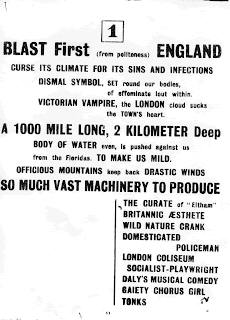
It seems hard to conceive, then, that Woolf did not know or hear about what was a remarkable and, ultimately, significant intervention on the stage of modernist aesthetics. However, nowhere in her diaries or letters for the period covering the two issues of
Blast! does Woolf make any mention of the magazine, or for that matter of Vorticism. She mentions Lewis and Pound only very briefly and tangentially. It seems odd that someone who was otherwise heavily engaged in the intersections of visual and literary art should be uninterested in a magazine which seems of its time quite important (if also self-important).
One reason for this gap might be that it is a wilfully cultivated ignorance, stemming from Woolf's antagonistic relations with both Pound and Lewis. In a letter of 1918 to Roger Fry, Woolf reports of her first meeting with Pound's protege, T.S. Eliot, whom she describes as a "strange young man." Their conversation got as far as discussing Pound, Lewis and Joyce, and whilst Woolf is inclined to agree with Eliot that the latter is a "great genius," she says of Pound: "Not that I've read more than 10 words by Ezra Pound by [sic] my conviction of his humbug is unalterable." Was
Blast! just another example of his "humbug," and so not worthy of mention?
Woolf and Lewis were similarly conflicted. Lewis had been prompted to develop Vorticism after falling out with Roger Fry, who had mentored Lewis at his workshop at the Omega gallery and who included Lewis in his second exhibition of post-impressionist painting in 1912. In 1914, feelings between Lewis and Fry were still raw, and Woolf's allegiances certainly lay with the latter, with whom she sustained a long correspondence and whose art theories influenced her later prose. Conversely, Lewis would later (in 1938) describe Woolf as "a sort of party-lighthouse," a symbol for the feminist movement but of exaggerated literary importance. So was Woolf allying herself with her friend by refusing to read
Blast!?
Both of these seem reasonable possibilities. The third option is that Woolf did in fact read or at least know of
Blast! but did not comment upon it explicitly in her letters or her diaries - hence why I have been unable to track down any mention of the magazine in her writings. However, the fourth possibility is that, not being a scholar of the modernist period, I may well be missing some glaringly obvious link or a reference to
Blast! or the Vorticists elsewhere in Woolf's writing. If anyone can get in touch to correct me, or to confirm that indeed Woolf either did not read or did not comment on this particular movement, I would be very grateful.
Labels: Blast, English Literature, Ezra Pound, Virginia Woolf, Vorticism, Wyndham Lewis
My students on my
literature course at the
Open University have just received their exam results. As usual, most have done as expected based on their work throughout the year, some have overperformed slightly, and a significant minority have done worse than they would have liked and worse than they perhaps deserved.
I am generally an advocate for exams as a fair assessment of a student's ability - even if they may not seem fair from the point of view of the student, whose year of hard work boils down to their performance in three hours. Although it is always sad to see a good student pulled down by an exam result, exams effectively discriminate between those who genuinely know their subject and who can think and write on the fly, and those who have succeeded through the year by marshalling their research (including from the web) for a prepared essay.
However, there is one key unfairness built into the system, particularly for those students who do not do so well. At present, it is very difficult for students to get feedback on an exam, and to use it as a learning experience. The Open University is better than most, as at least students get a question and marks breakdown which indicates whether aspects such as their "focus on the question" or "use of evidence" was poor, adequate, good etc. Nevertheless, even this is only of limited use. It frustrates me as a teacher that when a student contacts me and pleads to know why they have underperformed and even failed their exam, I can do little but apologise for being as in the dark as they are. Just as the exam is distinct from essay work throughout the year, so it is opposed to my desires as a teacher.
To my mind, students ought to be allowed to request to see a copy of their exam. Of course, this will add a significant administrative burden on universities. It will also risk students appealing their results. This is why markers are discourage from putting notes on scripts, as it would be wrong for students to count up the number of ticks or crosses or comments, and assume that this should correlate with their overall mark. Nevertheless, I strongly suspect that most students are mature and clear-headed enough to reflect objectively on their own work. Caught up in the moment of an exam, students can feel like they are writing the most brilliant essay. But with greater critical distance, most students would be able to recognise for themselves that their work under these conditions was not as good as it could or should have been.
Especially as students are paying up to £9000 a year to study, they will increasingly expect the exam to become an intrinsic part of their learning process, rather than a rite of passage at the end of the year that seems to bear little resemblance to their work throughout it. From the point of view of a teacher, the integration of exams into the cycle of assessment and feedback is something I would certainly welcome.
Labels: exams, Open University, University Life


 It seems hard to conceive, then, that Woolf did not know or hear about what was a remarkable and, ultimately, significant intervention on the stage of modernist aesthetics. However, nowhere in her diaries or letters for the period covering the two issues of Blast! does Woolf make any mention of the magazine, or for that matter of Vorticism. She mentions Lewis and Pound only very briefly and tangentially. It seems odd that someone who was otherwise heavily engaged in the intersections of visual and literary art should be uninterested in a magazine which seems of its time quite important (if also self-important).
 , I offer one definition of "art" that seems to fit very well with video games, as well as with literature and paintings. In this case, art is defined as a work which makes full use of the opportunities for expression that are available to it. Video games have available to them multiple media for expression (audio-visual, simulation, gameplay satisfaction), and this definition of art suggests that video games must satisfy a wider range of criteria for "success" than other creative forms. Usefully, this definition also means that we can still treat older games, which fully exploited the hardware of their own generation, as being artful in their own way.

 |
|

